Best Shoes for Babies Learning to Walk:Top Picks by Mom of 6
Our second baby, Aiden, spent the better part of two months refusing shoes. He walked at 14 months, and every pair we tried came straight back off — not a fussy five minutes, a flat refusal. We went through several before a pair of PediPed Originals finally stayed on his feet. Our first, Avery, had walked at 11 months and accepted shoes the day we put them on her.
Same house, same parents, two completely different sets of feet and opinions. That is the honest starting point for this guide: there is no single best first shoe, only a shoe that suits a particular foot, a particular stage, and a particular level of tolerance for being held still while you fasten a strap.
What this guide is built on. I have six children and have been buying their shoes since 2008 — somewhere between 90 and 100 pairs. Of the nine shoes below, six were worn by my own kids and were bought with my own money. Three I have researched but never put on a child’s foot, and I have labelled those clearly at the top of their sections rather than writing around the gap. Where a claim comes from another parent, a manufacturer, or an owner review rather than from me, the sentence says so.
The short version. If your child is walking outdoors and you want one pair that handles most of it, the Stride Rite Soft Motion Artie is the one I reached for most often. If your baby has a wide or deep foot and you have been fighting straps that will not close, go to the See Kai Run Stevie Mini. And if your child is not yet walking outside the house, you may not need any of them — bare feet indoors are still the recommendation, and I explain below where that stops being true.
What a first shoe actually has to do. In order of importance: protect the sole of the foot from whatever is outside, stay on without squeezing, let the foot bend and grip the way a bare foot would, and go on and off fast enough that you can leave the house. Everything else — memory foam, recycled linings, colourways — sits below those four. If a shoe fails the first four, no feature list rescues it.
What I ruled out before ranking anything. Nothing with a rigid, non-bending sole. Nothing with a built-in arch support, because an unprescribed arch support in a toddler shoe is solving a problem most toddlers do not have — flat-looking feet are normal at this age and arches usually appear between two and six. Nothing that fastens with laces only, because you will be retying them on the pavement. And no boots or high-tops sold on the promise of “ankle support” for a typically developing child: ankle strength comes from wobbling, and there is no good evidence a high collar improves stability in healthy new walkers.
A word about money before you scroll. At a size change every two to three months, a $52 shoe is costing you roughly $18–$26 a month, and there is no version of this where you buy one good pair and are finished for the year. That maths is the reason the budget pick sits at number four rather than number nine, and the reason I have flagged which of these are worth paying up for and which are not.
In This Guide
Best Shoes for Babies Learning to Walk
Before the list, one thing worth being straight about. A shoe is protection, not treatment. If your baby is toe-walking persistently, has feet that turn in noticeably, or seems unusually floppy through the ankles, a pair of sneakers is not the intervention — an appointment is. I say that as someone who spent a while hoping otherwise.
My daughter Avery had weak leg muscles and it worried me a great deal at the time. What I would tell my younger self is that the shoes mattered less than I thought and the timeline mattered more — she got there. Good shoes made her steadier on hard floors and stopped me from dressing her in something that actively got in her way. They did not do the developmental work. Her legs did.
How I judged these nine. The same seven questions for every shoe, in the same order: who the shape actually fits, how it goes on when the child does not want it to, what the sole does underfoot, how it grips, what it looks like after months rather than days, whether the sizing runs true, and how long I watched it for. Those last three are the ones no product page will tell you, and they are usually what decides whether you regret the purchase.
One product I used and did not include: the PediPed Originals that finally worked for Aiden. They earned their place in our house by solving a specific problem — a child who would not tolerate anything stiff — rather than by being a good general first shoe, and I have not handled the current version, so I am not going to rank a shoe I last used several children ago.
In the table, Used means my own child wore that shoe and I am describing what I saw. Researched means I have gone through specifications, the APMA listing, and owner reports but have never had the shoe in my hands. Both kinds are useful. They are not the same kind, and mixing them up is how buying guides end up sounding confident about things nobody checked.
Prices move constantly on Amazon and by size and colour, so the table gives a band rather than a figure that will be wrong by the time you read it. Tap through for the current price.
| # | Shoe | Best for | Fit & width | How it fastens | Evidence | Price |
|---|---|---|---|---|---|---|
| 1. | Stride Rite Soft Motion Artie Sneaker | Best overall | Average to slightly wide; wide width sold separately | One hook-and-loop strap | Used — Fiona, from 12 months | $$$ |
| 2. | See Kai Run Stevie Mini | Widest, deepest fit | Wide and deep; the one to try when straps will not close | Hook-and-loop | Used — Theo, infant 6 | $$$ |
| 3. | Ten Little First Walker | Closest to barefoot | Foot-shaped, roomy toe; suits chunky feet | Hook-and-loop | Used — Sawyer | $$ |
| 4. | Saucony Baby Jazz Hook & Loop Sneaker | Best value over time | Wide-fit last; true to size in our house | Hook-and-loop | Used — Sawyer, 12 months to age 6 | $$ |
| 5. | Stride Rite Zips Runner Sneaker | Fastest on and off | Runs small — size up half to a full size | Hook-and-loop with elastic faux laces | Used — Theo, about a year | $ |
| 6. | New Balance 574 Hook & Loop | Most colour choice | Adjustable across a range of foot shapes | Hook-and-loop | Researched — not handled | $$$ |
| 7. | Merrell Kids’ Bare Steps A83 Sneaker | Roughest outdoor use | Extra-wide toe box; good for chunky feet | Hook-and-loop — child-openable | Used — Sawyer, from her 1st birthday | $$$ |
| 8. | Stride Rite SM Tobias | Warm weather | Wide opening; two colours only | Hook-and-loop, oversized opening | Researched — not handled | $$$ |
| 9. | Robeez Soft Soles Crib Shoe | Pre-walkers and indoors only | Soft, stretchy, forgiving | Elasticated ankle | Researched — not handled | $ |
Price bands: $ = under about $35, $$ = about $35–$50, $$$ = about $50 and up. Amazon prices swing by size and colour, so treat these as a rough tier, not a quote.
1. Best Overall: Stride Rite Soft Motion Artie Sneaker
Evidence: used. Fiona wore these from around her first birthday. Bought with my own money.
This is the pair I reached for without having to think about it. That is a lower bar than “best shoe made” and a far more useful one, because the shoe you can locate and fasten in ninety seconds while a toddler leans away from you is the shoe that actually gets worn.
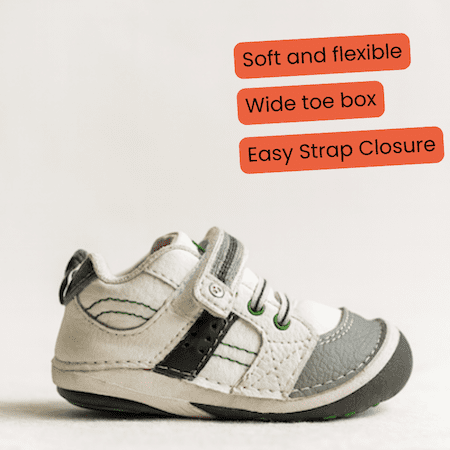
Stride Rite’s Soft Motion line appears on the APMA’s accepted-footwear register. Worth knowing what that does and does not mean: the brand submitted the shoe, a panel of podiatrists reviewed it, and it was judged to allow normal foot function. APMA is not a testing laboratory and does not assess shoes nobody sends them, so a missing seal tells you nothing at all.
I bought these for Fiona at a year old and she took to them straight away. With a new walker, a shoe she does not object to is most of the review.
What they are like to own
Sizing. The range runs from infant through toddler, so an early walker at ten months and a late one at sixteen are both covered, and you are not forced into a different model when they move up. Price varies by size and colour rather than by anything you get — the smallest sizes in plainer colours are usually the cheapest, which is worth remembering when the first pair only has to last eight weeks.
Fit. The toe box is roomy enough that toes can spread on each step, which is what you want — a new walker grips with their toes to balance, and a tapered toe box takes that away. Check it with your thumb: press down over the longest toe with the child standing, and you want about a thumb’s width of space in front of it. Do it standing, not sitting; the foot lengthens under weight.
Grip. The rubber outsole held on the surfaces we walk on — pavement, indoor tile, playground rubber. It is worth saying plainly that no shoe stops a new walker falling. Falling is the process. What a good sole does is remove the extra skid that comes from a hard, slick outsole on a smooth floor, so the falls are the ordinary kind rather than the feet-shooting-out kind.
Underfoot. The Ortholite footbed is a soft memory-foam insert. In a toddler shoe, cushioning matters less than people assume — a 22-pound child is not generating impact forces that need absorbing — but it does stop seams and stitching pressing into a soft foot, and it makes the shoe more comfortable barefoot on a hot day.
Getting them on. The opening stretches, so the shoe goes over a foot that is curling away from you instead of requiring you to thread it in. That single feature is the difference between shoes on in ninety seconds and shoes on in five minutes, and it is the reason this pair outranks better-specified shoes further down the list.
Cleaning. A damp cloth handles ordinary dirt on the leather. It will not handle mud ground into the mesh panels, and these do not go in the machine, so pick a darker colour if your child is the kind who finds every puddle.
If the standard width is tight, the wide version exists and is usually the answer before you conclude the model is wrong. A shoe that leaves a red line across the top of the foot when it comes off is too narrow, not too small — sizing up in the standard width just gives you a long shoe that still pinches.
Value. At the top of the price band, this is not cheap for something outgrown in about ten weeks. What you are paying for is the strap, the stretch opening and the width option — the friction reducers. Whether that is worth roughly $20 a month is a fair question, and the answer is different if this is your one outdoor pair than if it is your third.
Buy these if you want one pair that covers most outdoor walking and you value speed of getting them on. Skip them if you need rain protection, if your child’s feet are wide enough that even the wide version marks them, or if you are buying a first pair for a child who is not yet walking outdoors — in that case you are paying for a sole they do not need yet.
2. Best for Wide & Chubby Feet: See Kai Run Stevie Mini
Evidence: used. Theo wore these in an infant 6. Bought, not sent.
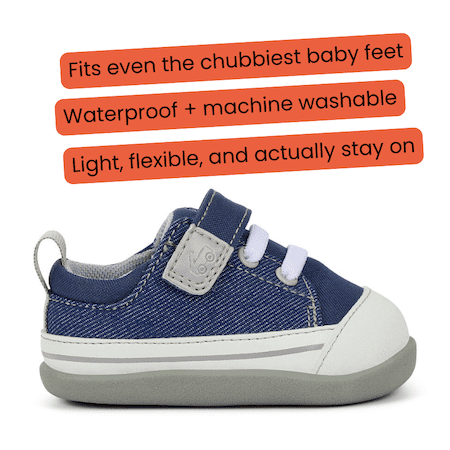
If you have already bought two pairs that would not close over the top of your baby’s foot, the problem is probably depth rather than length. Baby feet are not simply small adult feet — they are wide and, more importantly, thick through the instep, and most shoes are cut for a flatter foot.
This is the shoe I would try next. Compared with the Stride Rite Artie above, the Stevie Mini opens wider and takes a deeper foot without the strap running out of Velcro.
The toe box is generous too, but the fit difference that matters is over the instep, not at the toes.
The upper is soft enough that it moves with the foot rather than resisting it, which is useful for a child still cruising along the furniture and spending as much time crouching and standing up as walking. The trade-off is that a soft upper holds its shape less well over months — see the note about the tongue below.
What they are like to own
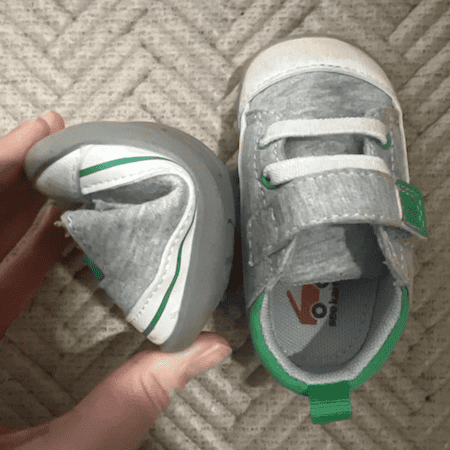
I bought Theo an infant 6 and he wore them happily — no pulling at them, no sitting down to get them off, which for him was not a given. I would not claim the shoe made him steadier on his feet; I can only tell you it never seemed to be in his way.
Breathability. The mesh lining moves air, which matters mostly for smell rather than health — a sweaty toddler foot in a sealed shoe develops an impressive odour within a week. Athlete’s foot, which gets cited a lot in guides like this one, is genuinely uncommon before puberty.
Cleaning and wear. These are machine washable and come out of a cold wash without losing their shape. I still spot-clean and air-dry by preference, because repeated washing softens any glued shoe faster than the label admits. The colour range is small and the size range is narrower than the Stride Rite — roughly sizes 3 to 6 — so at some point you will have to move to a different model rather than the next size up.
Buy these if your baby has a wide or deep foot and you have already returned a pair that would not close, or if you want something you can put through the washing machine. Skip them if your child has a narrow foot — the same generous opening that solves one problem creates the other, and a loose shoe on a new walker is worse than a snug one. Also skip if you want the shoe to last across several sizes; the range runs out sooner than most.
3. Best for Natural Foot Development: Ten Little First Walker Baby Shoes
Evidence: used. I bought a pair for Sawyer. Cotton upper, natural rubber outsole, vegan construction, and on the APMA accepted list.
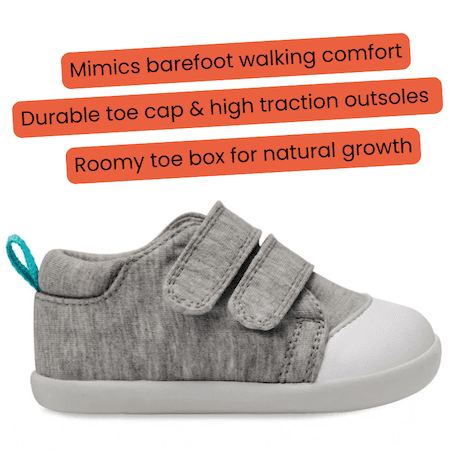
This is the closest thing here to walking barefoot with a layer of rubber underneath. The last is foot-shaped rather than shoe-shaped — widest across the toes, where a foot is actually widest, instead of tapering to a point.
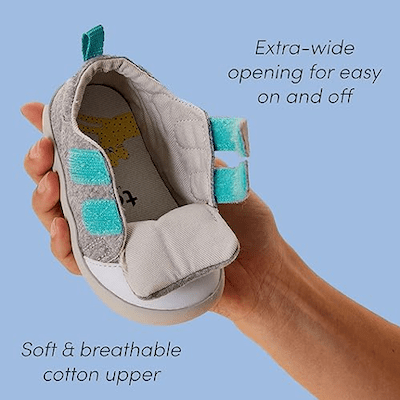
The upper is soft cotton, so it breathes well and gives immediately rather than needing breaking in.
The sole is zero-drop, meaning the heel and forefoot sit at the same height. In an adult shoe that is a preference. In a first shoe it matters more: a raised heel tips a beginner walker slightly forward, and beginners are already tipping forward.
What they are like to own
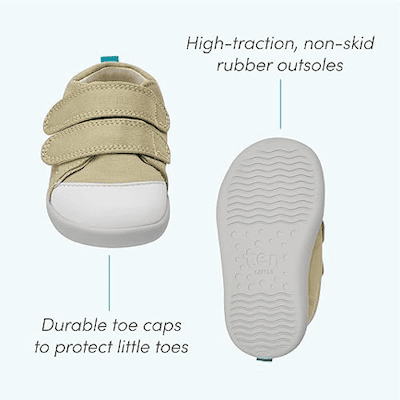
Grip and sole. The natural rubber outsole is thin, which is the point and also the limit. It gives good grip and a lot of ground feel, and it is the wrong shoe for gravel or a stony path, where a thicker sole earns its bulk. On grass, pavement and indoor floors it is excellent.
Flexibility. When Sawyer’s pair arrived I was surprised how far they bent — you can fold one nearly in half. That is a feature, not a defect, but it changes what you should expect: this shoe protects the sole of the foot and does very little else. If you were hoping a shoe would hold a wobbly ankle steady, this is not that shoe, and honestly nothing sold as a sneaker is.
Sizing. The included paper foot sizer is more useful than it sounds, because measuring a baby’s foot properly means doing it standing, with weight on it, late in the day. Measure both feet — they are often a half size apart — and fit the larger one.
Buy these if you want the least shoe that still counts as a shoe, your child walks mostly on grass, pavement and indoor floors, and you like the idea of a foot-shaped last. Skip them if your walks involve gravel or rough trails, if you need one pair to survive daycare, or if white toes will bother you within a fortnight.
4. Best Budget-Friendly: Saucony Baby Jazz Hook & Loop Sneaker
Evidence: used, and for longer than anything else here. Sawyer’s first pair went on at 12 months and she was still wearing the model at six. Bought, several times over.

This is the one on the list I can speak about over years rather than months, and the observation that matters is not comfort or looks. It is that the model kept working as the child changed.
Before we found these, Sawyer was destroying shoes in two to three months — faster than she was outgrowing them, which is the expensive kind of problem. She was a wiggly toddler and hard on everything.
Her first pair went on at 12 months. She turned six in 2025 and still asks for them. We have gone up several sizes and the fit has stayed recognisably the same each time, which is worth more than it sounds — most brands quietly change the last between the infant and little-kid ranges and you end up re-solving the fit problem from scratch.
What they are like to own
Durability, which is the whole argument for this shoe. The suede-and-nylon upper resists scuffing better than the mesh-heavy alternatives here, and the stitching held where cheaper shoes let go at the toe seam.
How long they actually last. Be careful with “lasts over a year” claims, mine included. In our house a pair survived well past the point where the foot had outgrown it — which is the honest version. Between 12 and 30 months you will need a new size roughly every two to three months regardless of how well the shoe is holding up, so durability here buys you hand-me-downs and resale value, not fewer purchases. It starts saving you real money at three or four, when growth slows down.
Fit and closure. The last is cut wide, so this handles a chunky foot without going up a length. The hook-and-loop strap adjusts across a decent range, though not as far as the See Kai Run. The EVA midsole is thicker than the Ten Little’s — you lose some ground feel and gain some protection, which is the right trade for a child who is running rather than taking first steps.
Where they fall down. Suede and rain do not get on. It marks, it darkens, and it does not recover the way leather does. This is a dry-day shoe that happens to be tough, not a tough shoe for all weathers — a distinction the product photos will not make for you.
Buy these if you want the best cost-per-wear on the list, your child is hard on shoes, or you have a younger sibling coming who will inherit them. Skip them if you walk in wet weather, if your child’s foot is narrow, or if you want the most flexible sole here — that is the Ten Little, and this is deliberately more shoe than that.
5. Best Easy-On/Off Shoe: Stride Rite Soft Motion Zips Runner Sneaker
Evidence: used. Theo wore these for about a year. Bought, not sent. The laces are decorative elastic and the shoe actually fastens with a hook-and-loop strap — they look like lace-ups and behave like Velcro, which is the entire point.
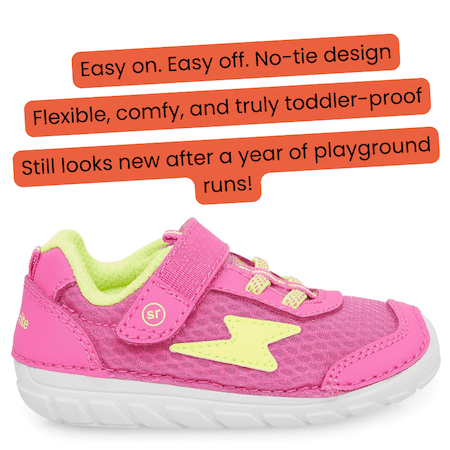
This is the cheapest shoe here and the one I would hand to someone buying their very first pair. Not because it is the best made — the Saucony is tougher and the See Kai Run fits more feet — but because it costs the least to be wrong about.
The sole is rounded at the edges rather than squared off, which reduces the number of times a foot catches its own shoe on the way through a step. The footbed is the same Ortholite memory foam as the Artie at number one.
What they are like to own
After a year. Theo wore his for about twelve months and they still looked close to new at the end of it. I want to be precise about what that does and does not tell you: it means the uppers and sole survived a year of ordinary wear, not that one pair covered a year of growth. It did not, and it will not for you either.
Cleaning. Washer and dryer, which quietly makes this the most practical shoe here if your child goes to daycare or spends time in a sandpit. Compare the Artie at number one — same brand, same footbed, wipe-clean only. If you have ever tried to get playground sand out of a shoe with a damp cloth, that difference is worth more than most of the features on either product page.
Grip and getting them on. The rubber outsole grips well on indoor floors, which is where most early stumbles happen. The heel loop is small but real: once a child is around two they can hook a finger in and pull the shoe on themselves, which is the beginning of you not having to do it.
Buy these if this is your first pair and you would rather not spend $50 finding out what your child tolerates, or if you need something washable and are on a budget. Skip them if neither colour works for you, or if your child is between sizes and you are not willing to gamble on sizing up.
6. Best Versatile/Stylish: New Balance 574 Hook & Loop
Evidence: researched, not used. I have never had these on one of my children’s feet. Everything below comes from the specification, the APMA listing and what owners report — there is no personal observation in this section and I am not going to pretend otherwise.
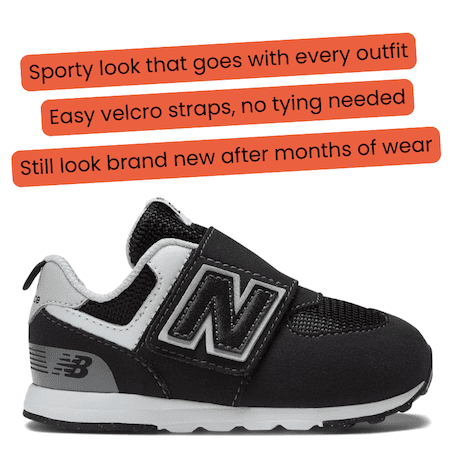
The 574 is a long-running adult silhouette scaled down, which explains both its appeal and its main limitation. New Balance Kids has several models on the APMA accepted list; check the specific style you are buying rather than assuming the seal covers the brand.
What it clearly offers is choice — a wide colour range, and a shape most parents already know how to judge on sight.
What the specification says — and what it does not
On paper the 574 covers the basics: adjustable strap, rubber outsole, room across the forefoot. Nothing in the specification disqualifies it as a first shoe.
The thing to check yourself in the shop or on arrival is the flex. Hold the heel in one hand and push the toe upward: it should fold at the ball of the foot, roughly a third of the way back. If it bends in the middle of the arch instead, or barely bends at all, it is the wrong shoe for a beginner whatever the reviews say. The 574 has a more built-up sole than the Ten Little or the Stride Rites here, so this is the check that matters most.
The other thing worth knowing: this silhouette has a visible heel lift. On an adult that is unremarkable. On a child taking their first independent steps it tilts them very slightly forward, and beginners are already fighting to stay behind their own feet. It is a small effect and plenty of children walk fine in them — but if you are choosing between this and something flatter for a brand-new walker, that is the reason to choose flatter.
Consider these if you want a familiar sneaker look in a colour nothing else offers, and your child is already walking confidently rather than taking first steps. Skip them if you are buying a genuine first shoe, if the price matters, or if you want a recommendation backed by someone who has actually used them — for that, go to number one or number four.
7. Best for Outdoor Durability: Merrell Kids’ Bare Steps A83 Sneaker
Evidence: used. I bought these for Sawyer as a first-birthday present and she wore them outdoors. Merrell Kids also has models on the APMA accepted list.
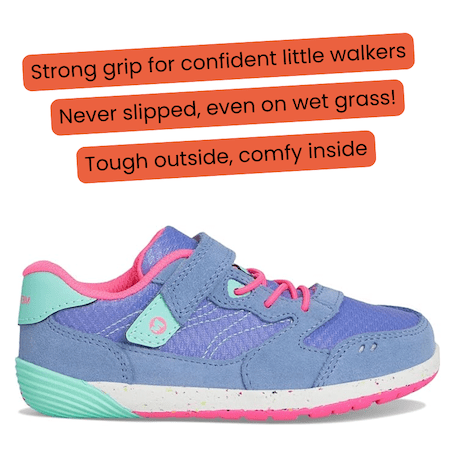
Outdoors is where a shoe stops being optional. Uneven ground, gravel, hot pavement and other people’s broken glass are the actual reasons a walking baby needs something on their feet — not support, not correction, protection.
I have bought several pairs from Merrell Kids over the years. This is the model I would choose for rough ground: more sole underneath than the Ten Little, a proper toe bumper, and enough tread to deal with wet grass and dirt.
What they are like to own
Grip and protection. Non-marking rubber outsole with multi-directional flex grooves — those channels let the sole bend in more than one direction and give water somewhere to go so the rubber can still meet the ground. The rounded toe bumper is the part that earns its money: a new walker meets kerbs toe-first, repeatedly.
Materials. Recycled PET lining, roughly 10 per cent recycled EVA in the footbed and 20 per cent recycled rubber in the outsole, per the brand. Worth knowing what that is: a meaningful share of some components, not a fully recycled shoe. Five colours, unisex.
Sole. Zero-drop, so the heel and forefoot sit level — the same principle as the Ten Little, but with considerably more material underneath. That is the trade you are making: less ground feel, more protection from what is on the ground. For a garden, a park and a pavement, it is the right trade.
The stretch that told me something. Sawyer wore these for three to four hours at a stretch without her feet hurting or her asking to have them off. She has chunky feet and had not been comfortable in much before this; the extra-wide toe box is the reason. A three-hour window is the longest single wear I can vouch for — I have not tested a full day of hiking, and I am not going to imply I have.
The thing nobody warns you about. The strap is easy enough to open that Sawyer worked it out herself, and after that she took her shoes off whenever she felt like it — in the trolley, in the car, halfway down the street. There is no fix; it is the flip side of a closure a toddler can manage. If you are somewhere you cannot afford a bare foot, put a sock on first so at least you notice, and check for both shoes before you leave anywhere.
Buy these if your walks involve gravel, trails, wet grass or a lot of kerbs, or if your child has a genuinely chunky foot that other shoes squeeze. Skip them if you mostly walk on pavement and indoor floors — you are paying for sole you will not use — or if a self-removing toddler would be a real problem in your week.
8. Best Sandals for New Walkers: Stride Rite SM Tobias
Evidence: researched, not used. I have not had these on a child’s foot. This section is built from the specification, the APMA listing and owner reports, and I have kept it short because that is all I have.
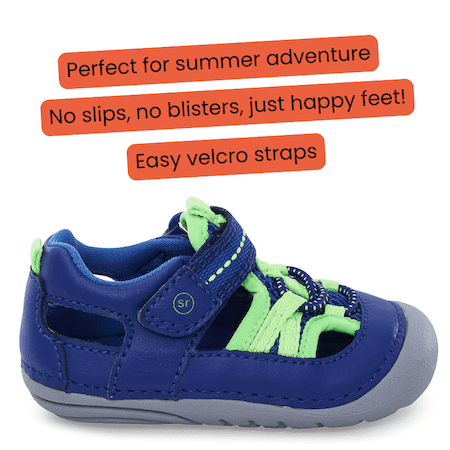
The case for a sandal in this age group is simple: in hot weather a closed shoe means a damp foot, and a damp foot in a warm shoe is where blisters and smell come from. An open sandal removes the problem rather than treating it.
Stride Rite’s Soft Motion construction — flexible, rounded rubber soles — is the same platform as the Artie at number one, in sandal form. Note the word used in the brand’s own material is that it encourages natural movement, which is a claim about design intent, not a demonstrated developmental outcome.
What the specification says — and what it does not
On specification the Tobias is a closed-toe sandal on Stride Rite’s first-walker platform, in sizes 3 to 6 and two colours. A closed toe matters more than the seal does: an open-toe sandal on a new walker means stubbed toes on every kerb.
The adjustable strap and rounded outsole are the same features that work well on the Artie. What I will not tell you is that they eliminate trips and falls, because nothing does and any guide that says so is selling you something.
The lining is treated to reduce odour. The size range, 3 to 6, is narrow — realistically one summer, possibly two if your child’s growth is slow and the season is short.
They can be worn with or without socks. Without is the point in hot weather; with socks, check the fit again, because a sock takes up more room in a sandal than people expect and can turn a good fit into a tight one.
Consider these if you are heading into a hot summer with a child who is already walking and you want their feet cooler than a sneaker allows. Skip them if you want a recommendation from someone who has used the product — I have not — or if you need one pair to cover the whole year. A sandal is a second pair, not a first one.
9. Best Pre-Walker Shoes (Crib Shoes): Robeez Soft Soles Crib Shoe
Evidence: researched, not used. I have not put these on one of my own children. Read this section as what the product is, not as a recommendation from experience.
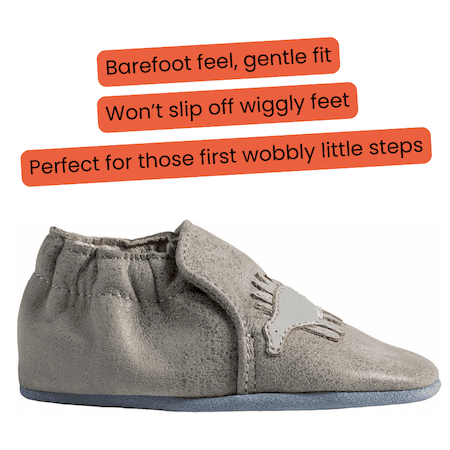
Read this bit before you buy. These are crib shoes. They are for babies who are not yet walking outdoors — crawlers, cruisers, and the very first indoor steps.
The soft suede sole gives grip on indoor floors without putting anything rigid between the foot and the ground, which is as close to barefoot as footwear gets.
What they will not do is protect a foot outdoors. There is no sole to speak of, so gravel, hot pavement and anything sharp go straight through. If your baby is walking outside, this is the wrong entry on the list and you want one of the first seven.
What they are for — and when to stop using them
The elasticated ankle is the feature that matters: it is what stops a baby kicking them off, which is what happens to almost every other soft shoe in this category. The suede upper has no stiffness anywhere, and the lining breathes.
There are a lot of designs, including licensed character prints, across five sizes for infants under 12 months. The size range is the honest signal here: this is a product with a window of a few months, and it closes when your child starts going outside on their feet.
Buy these if you have a crawler or cruiser sliding around on hard floors, or you need something warmer than bare feet that will not come off. Skip them if your child is walking outdoors, if your floors are carpeted — bare feet are fine and free — or if you were hoping these would double as outdoor shoes. They will not.
How to Choose the Best Shoes for Babies Learning to Walk
Avery walked at 11 months and moved from barefoot to shoes without complaint. Terry and I bought her a pair for every occasion — sneakers, boots, little flats — and kept them in their own corner of the house. I thought we had worked out how this went.
Aiden corrected me. He walked at 14 months and reacted to every new pair the same way — not fussing, refusing. We worked through several before the PediPed Originals stayed on, and the thing that finally worked was not a feature on a box. It was slowing down: letting him wear them indoors for ten minutes at a time before we expected a whole outing from them. The shoe corner had made me think buying was the skill. It is not; fitting and pacing are.
If your baby is currently pulling their shoes off and throwing them, that is worth knowing: it is common, and it is usually about the sensation being new rather than about the shoe being wrong. Try short indoor stretches first. But check the fit before you assume it is protest — a red mark across the top of the foot or across the little toe when the shoe comes off means it is the shoe, not the mood.
One more thing worth saying plainly, because most guides in this category imply otherwise: shoes do not teach walking and do not speed it up. Indoors, on safe floors, bare feet remain what the American Academy of Pediatrics and the pediatric podiatry guidance point to — the foot gets more feedback and does more of its own work. Shoes are for outside. Everything below is about choosing a good one for outside, not about hitting a milestone sooner.
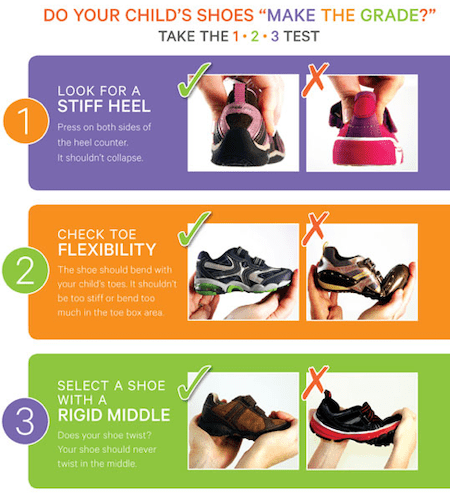
The three-point check. Before anything else, do this to any shoe you are considering, in the shop or the moment the box arrives. One: hold the heel, push the toe up — it should fold at the ball of the foot, about a third of the way back, not in the middle of the arch and not barely at all. Two: hold heel and toe and twist gently — there should be some give, but the midfoot should resist. Three: squeeze the heel cup from both sides — it should hold its shape rather than collapse flat. Any shoe that fails all three is a slipper. Any shoe that passes all three too rigidly is a boot. You want the middle.
1. What the APMA seal does and does not tell you
The seal is the first thing every buying guide tells you to look for, including this one — so it is worth understanding properly rather than treating as a pass mark.
This is when APMA– American Podiatric Medical Association comes to help! These associations have set standard measures to rate baby shoes. All shoe brands having the APMA Seal are considered healthy and good for babies’ feet.
Two consequences follow. A shoe without the seal is not worse — it may simply never have been sent in, which is true of a great many small and barefoot-style brands. And a shoe with the seal has cleared a floor, not a podium: it was judged to allow normal foot function, which is a different claim from being the best thing for your particular child’s foot. Use the seal to rule things in, never to stop looking. Then run the three-point check yourself, because that tells you about the shoe in your hand.
2. Weight — and why it matters more at this age
A new walker has very little margin. They are already lifting a foot they cannot fully control, swinging it forward, and hoping. Add meaningful weight to the end of that leg and you get more toe-catching and more stumbles — the shoe changes how the leg swings.
Practically: pick the shoe up. If it feels substantial in your hand, it is substantial on a 22-pound child. Compare two pairs by holding one in each hand — the difference is obvious and no product page publishes the figure. This is where scaled-down adult sneakers lose to purpose-built first shoes, and it is a real part of why my top picks are the ones they are.
3. Toe box — how to tell if it is actually wide enough
A new walker grips with their toes. Watch a barefoot baby on a hard floor and you will see the toes spread and press down on every step — that is part of how they balance. A tapered toe box takes that away, which is the real cost of a narrow shoe, well before anything hurts.
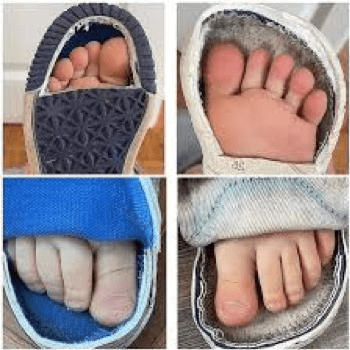
The test takes ten seconds: with the child standing and weight on the foot, press down over the longest toe. You want roughly a thumb’s width in front of it. Do both feet — they are often half a size apart — and fit the bigger one. And take the shoe off after twenty minutes and look at the foot: red lines across the top or the outside of the little toe mean too narrow, not too short, and going up a length will not fix it. You need a wide version or a different last.
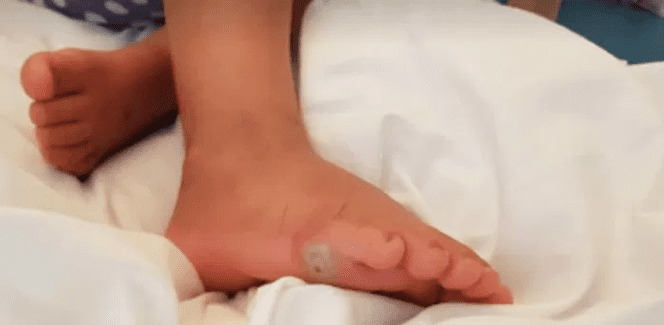
Room at the toes lets the foot do its own balancing work.
Check it standing, late in the day, when feet are at their largest.
Fit the larger foot; a half-size difference between feet is normal.
4. Grip — what actually stops a slide
Look for soft, slightly tacky rubber rather than hard plastic — press a thumbnail into the outsole and you want it to give a little.
You will read that tread grooves create suction. They do not — grip on a dry floor comes from friction between the rubber and the surface, and that is mostly about how soft the compound is. What the grooves do is give water and grit somewhere to go, so the rubber can still reach the floor instead of riding on top of a film. That is why tread matters outdoors and on wet tile, and matters very little on a dry wooden floor.
The place this genuinely matters is your own kitchen and bathroom. Most first-walker falls happen indoors on smooth hard floors, and hard plastic soles are dramatically worse there than soft rubber or TPE. To be clear about what grip buys you: fewer feet-shooting-out slides, not fewer falls. New walkers fall constantly and that is how they learn. You are removing one specific failure mode, not the process.
5. Flexibility — and the limits of it
The shoe should get out of the way. Soft upper, thin sole, no built-in arch shape. Babies twist their feet, roll onto the outside edge, crouch and stand — a stiff shoe stops all of that, and the foot muscles that would have been working are the ones that build strength.
Where flexibility stops being a virtue is on rough ground. A paper-thin sole on gravel means every stone is felt, and a child who is being hurt by the ground walks worse, not more naturally. This is the whole reason the list above ranges from the near-barefoot Ten Little to the more substantial Merrell: it is a terrain decision, not a philosophy.
The collar should sit below the ankle bone. High-tops are widely sold on the promise of ankle support, and for a typically developing new walker there is no good evidence they provide it — ankle stability is built by the wobbling, and a high collar mostly restricts the movement that would have built it.
What you do want at the ankle is a soft, padded edge so the collar does not saw at the skin, and a heel cup firm enough to hold its shape when you squeeze it. That combination keeps the heel seated without immobilising the joint above it.
6. Cost — the number that actually matters
Children between 12 and 30 months typically need a new shoe size every two to three months. That figure comes from a study that tracked foot growth in over a hundred children, and it slows after that — roughly every four months up to age four, every six months from four to six.
So measure every couple of months rather than waiting for a complaint — toddlers do not reliably tell you a shoe is tight, they just curl their toes and get on with it. And do the arithmetic before you fall in love with a pair: divide the price by ten weeks. A $52 shoe is about $5 a week. A $30 shoe is about $3. Over the first two years, that gap is a few hundred dollars.
Where paying more is genuinely worth it: a width option, a closure your child cannot defeat, and a size range that continues so you are not re-solving fit every few months. Where it is not: memory foam, sustainability claims, and anything about supporting an arch a toddler does not have yet. Flat-looking feet are normal at this age; arches usually appear between two and six on their own.
7. Durability — where shoes actually fail
New walkers do not wear shoes out evenly. They drag their toes, kneel, push off from the front of the foot, and go down on the same spot repeatedly. Almost every failure I have seen started in the same two places.
The toe goes first — scuffed, then abraded, then split at the seam where upper meets sole. The Velcro goes second: it fills with fluff and grit and gradually stops holding, which is the failure that actually ends a shoe’s life, because a strap that will not stay shut is a shoe your child removes at will. Pick the fluff out of the hooked side occasionally with a fingernail. It takes ten seconds and it buys weeks.
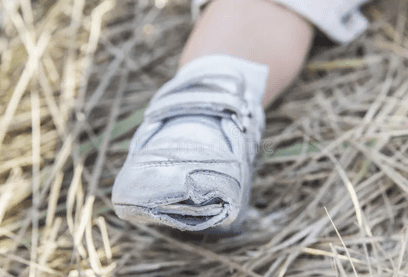
So look at the toe before you look at anything else. A rubber bumper wrapping up over the front is worth more than any other durability feature on the page, and it is the single clearest difference between the shoes here that survived and the ones that did not.
On materials: rubber and TPU outsoles last longer than foam ones. Some parents prefer organic cotton, suede, natural rubber or vegetable-tanned leather for what touches the skin, and those are reasonable preferences — though contact reactions to ordinary shoe materials are uncommon, so treat this as a preference rather than a precaution unless your child has a known sensitivity.
8. Breathability — mostly a smell problem
Toddler feet sweat a great deal for their size.
Seal that into a synthetic shoe worn every day and you get a smell that arrives faster than you would believe.
A damp foot also blisters more easily and gets irritated where a seam or strap rubs. Mesh panels and a breathable lining fix most of it; so does the boring fix nobody mentions, which is having two pairs and alternating, so each gets 24 hours to dry out properly.
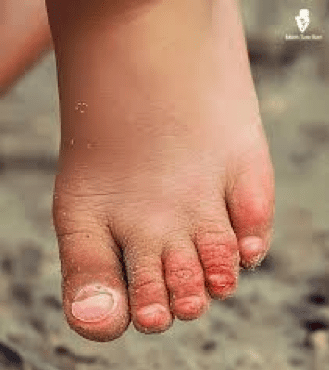
Guides in this category like to invoke athlete’s foot here. In fairness to the facts: tinea pedis is uncommon in children before puberty — it is largely a teenage and adult condition. It does happen, and an itchy scaly rash between the toes is worth showing a doctor rather than treating yourself. But it is not the reason to care about breathability. Comfort and smell are.
Practically: mesh panels over the forefoot, a lining that is not sealed plastic, and socks made of cotton or wool rather than pure polyester. Take the insoles out to dry if they lift, and air the shoes somewhere that is not a sealed cupboard.
The short checklist: bends at the ball, resists twisting in the middle, firm heel cup, thumb’s width past the longest toe when standing, light in the hand, soft rubber outsole, strap rather than laces, and a rubber bumper over the toe. If it clears those, the brand matters much less than the marketing suggests.
You may also like: How to Measure Baby Shoe Size
If your baby seems floppy through the feet and ankles
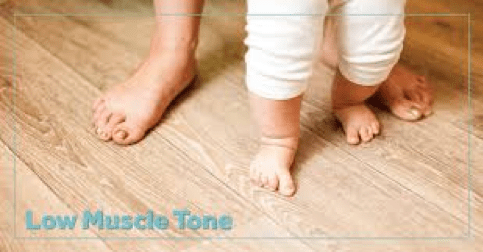
What “low tone” means
Low muscle tone — hypotonia — means muscles sit at a lower resting tension than usual, so a baby can feel unusually soft or floppy and has to work harder to hold a position. It is not the same as weakness; a child can be strong and still have low tone. The part I most want to pass on, because I did not understand it when Avery was small: hypotonia is a sign, not a diagnosis. It rarely occurs on its own, and finding out what is behind it is a job for your pediatrician and a pediatric physical therapist, not for a shoe.
Signs worth mentioning to your doctor
- Feet that point downward rather than sitting flat as the child begins to stand.
- Feet and ankles that feel unusually soft, and joints that move further than you expect.
- Gross motor milestones — sitting, pulling up, standing, walking — arriving noticeably later than expected.
- Difficulty taking weight through the feet when standing, or ankles that roll inward markedly.
Where footwear fits in — and where it does not
Please read this part carefully. Shoes do not treat low muscle tone and will not make it resolve. Anyone telling you otherwise — including the earlier version of this article, which said exactly that and was wrong — is overstating what footwear can do. If your baby has been diagnosed with low tone, the footwear question belongs to your physical therapist or pediatric podiatrist, because the right answer depends on what is causing it and how the child’s feet actually load. Some children are fitted with a more structured shoe or an orthotic; some do better in something minimal. That is a clinical judgement made on your child, not a shopping decision.
What therapists and specialist fitters commonly look at — useful for understanding a recommendation you have been given, not for making one yourself:
- Fastening that adjusts a long way: so the shoe can be held snugly without being tight.
- A firm heel cup: this is the feature most often mentioned, because it helps keep the heel seated rather than rolling.
- A wide toe box: toes that can spread contribute to balance, and this applies to every child.
- A sole with some structure but real flex: stable underfoot without locking the foot still.
Here is how the shopping question differs between a typically developing foot and one where low tone has been identified by a clinician. Note that the second column is a summary of what specialist fitters and therapists tend to prioritise — it is background reading for a conversation with them, not a substitute for one.
For the Typical Foot
- Barefoot indoors wherever it is safe — this is the standing recommendation.
- Light, so the shoe does not change how the leg swings.
- Wide toe box so the toes can grip and spread.
- Flexible, minimal sole for ground feedback; more sole only where the terrain demands it.
For the Low Tone Foot
- Barefoot time still matters, with your therapist advising when a supported shoe is worn instead.
- Light but more structured than a typical first shoe, in most fittings.
- Wide toe box, same as any other child.
- A firmer heel cup to help stop the ankle rolling inward.
- Possibly a higher collar or an orthotic — but only if it has been recommended for your child. High-tops are not an evidence-based choice for typically developing walkers, and for a child with low tone the decision belongs to the clinician who has examined them.
The Short Version, By Situation
Your baby is cruising along the furniture and has not walked outdoors yet. You probably do not need shoes at all. Bare feet indoors, and if your floors are slippery, the Robeez crib shoes stop the sliding for very little money.
First real outdoor shoe, and you have no idea what your child will tolerate. Start cheap. The Stride Rite Zips Runner costs the least to be wrong about and goes in the washing machine. Size up half to a full size.
You want one pair to handle almost everything. The Stride Rite Soft Motion Artie. Fast to fasten, comes in a wide width, sensible sole. Keep it out of the rain.
Straps will not close over your baby’s foot. Stop buying longer shoes — the problem is depth. Go to the See Kai Run Stevie Mini, which opens wider than anything else here.
Money is tight and there is a younger sibling coming. The Saucony Baby Jazz. Best cost-per-wear on the list and the pair most likely to survive to be handed down.
You want the closest thing to barefoot. The Ten Little First Walker, provided your walks are grass, pavement and indoor floors rather than gravel.
You are out on trails, gravel or rough ground. The Merrell Bare Steps A83 — more sole underneath and a proper toe bumper. Expect your child to learn to undo the strap.
Your child has been diagnosed with low muscle tone or any foot condition. None of the above. Ask your physical therapist or pediatric podiatrist what to buy, and take this list to that appointment rather than to a checkout.
FAQs About Baby Walking Shoes
When do we move from a first walker to a regular toddler shoe?
There is no age that triggers it. The change worth making is from a soft, minimal shoe to one with a bit more sole, and the signal is where your child walks rather than how old they are — once they are confidently covering ground outdoors on uneven surfaces, they need more underfoot. For most children that lands somewhere between 12 and 24 months. Do not rush it. There is nothing to gain from a more substantial shoe before the terrain requires one.
How do I know if the shoes are too small?
Do not wait to be told — toddlers curl their toes and carry on. Check with the child standing, weight on the foot, and press down over the longest toe: you want about a thumb’s width of space in front of it. Then take the shoes off after twenty minutes and look at the feet. Red lines across the top of the foot or along the outside of the little toe mean the shoe is too narrow, and going up a size will not fix that — you need a wide fitting or a different shape. Between 12 and 30 months, check every couple of months regardless.
Is it okay for babies to wear booties?
Yes, for warmth and for grip on hard floors. Booties are an alternative to socks rather than to shoes — they have no protective sole, so they are for indoors. If your baby is crawling or cruising, choose a pair with a non-skid sole, which is the difference between a bootie that helps and one that turns a wooden floor into a slide.
At what age should babies start wearing shoes?
When they start walking outdoors, not before. The purpose of a first shoe is protection from what is on the ground — hot pavement, gravel, sharp things — so a baby who is crawling and cruising indoors does not need one. Indoors, bare feet are still what the American Academy of Pediatrics points to, because the foot gets more feedback and does more of its own work. In practice most families need a first outdoor pair somewhere between 9 and 15 months.
What I’d Do Differently, and the One Habit Worth Keeping
With Avery I bought too many pairs and worried about the wrong things. I thought the shoe was doing developmental work it was not doing, and I spent money on features — cushioning, structure, the general aura of a serious shoe — that mattered far less than fit and weight. By the fourth child I was buying fewer pairs, cheaper, more often, and checking the fit rather than the reviews.
The other thing I got wrong was reading resistance as fussiness. When a baby pulls a shoe off repeatedly, the odds are decent that something is pressing. Take it off, look at the foot, and look for the red line before you conclude anything about their temperament.
If you take one thing from this page, make it the price-per-week arithmetic. Divide the cost by ten weeks. That number — not the brand, not the seal, not the colour — is what you are actually deciding on, and seeing it written down makes the choice between a $52 shoe and a $30 one considerably easier.
Somewhere between 90 and 100 pairs since 2008, across six children. I still get sizing wrong occasionally. The difference now is that I find out in a week rather than a month.
So here is the habit, and it is the only one that has ever saved me money. Once a month, on a day you will remember, stand your child up, press your thumb down over the longest toe of each foot, and look for a thumb’s width of space. Then take the shoes off and check the top of the foot and the outside of the little toe for red marks. Two minutes. It will tell you a size change is coming before your child gets uncomfortable, and before you have paid for a pair that fits for three weeks.