Best Baby Carriers and Wraps 2026 – My Top Picks as a Mom of 6!
Two of my six babies wanted opposite things from a carrier. Teagan would burrow into a Meh Dai wrap and stay there happily. Fiona had no patience for the wraps at all and settled in the structured Ergobaby instead. Same house, same parents, two completely different answers.
That is the part the product pages leave out. You are not buying for a stage, you are buying for a particular baby, and you find out which one you have after the box is open.
A carrier has to do four things at once, and they are worth putting in order, because that order is how I ranked everything below. It has to keep your baby’s airway clear. It has to support their back and hips. It has to move their weight onto your hips instead of your lower back. And it has to be quick enough to put on that you actually reach for it rather than leaving it in the closet. Almost every disappointment I hear from other moms is one of those four, and it is usually the last one.
This guide walks through the main types of carriers, who each one suits, who should skip each one, and the safety rules that matter far more than any feature list.
I want to be straight with you about where this comes from, because a lot of “best of” lists are not. I carried six babies over about fifteen years. Four of the carriers below I used myself. Two I bought as gifts for people close to me, watched in use, and got detailed feedback on. Two I have only researched and have never worn. Every pick is labelled with which of those it is, and with how I got hold of it, so you can weigh what I say accordingly. The safety and specification claims come from the manufacturers, the CPSC, the ASTM standards, and the American Academy of Pediatrics, not from me.
There are picks here for newborns, for twins, for the toddler up-down stage, and for parents who need something that folds into a diaper bag. There is also a list further down of what I deliberately left out, which tells you as much as the list itself.
With every one of them I ended up adjusting something, because children from the same two parents turn out startlingly different, and so do the two parents.

If you get stuck partway down, leave me a comment and tell me your baby’s weight and what is going wrong. That is usually enough to narrow it to one or two.
And there is no judgment here. I remember standing in a store aisle with a baby on my hip, reading the back of a box, with no idea what I was looking at. You will get this one right, and if you get it wrong the first time, so did I.
Best Baby Carriers in 2026
A carrier is one of the few pieces of baby gear you wear on your own body, so a bad fit costs you twice: your baby is uncomfortable and your back pays for it. Get it right and you buy back both hands, which at some stages is the whole day.
Across six kids I went through wraps, ring slings, soft structured carriers, a hip seat, and a framed hiking pack. I got plenty of it wrong on the way, including one thing I used to recommend to other mothers and now tell them not to do, which I explain further down rather than quietly leaving out.
With a gathered experience of 15 years, all I can say is carriers are good, but they are GREAT WHEN YOU ARE ALONE!
I have watched a lot of moms buy the wrong thing twice. It is almost always the same mistake: they bought for the baby they have this month rather than the one they will have in six months. Babies double their birth weight somewhere around five months, and a carrier that fits beautifully at 9 lb can be finished by the time they hit 20. The list below spans roughly $40 to $215, and the price is not what separates them. The stage is.
How I Rated These Carriers: My Evidence Tiers
Every pick below carries one of these three labels, plus a note on how I got hold of it. Nothing here was lab-tested by me. Where I have not worn something, I say so plainly rather than writing around it.
Tier 1 – Used it myself. One of my own six children rode in this carrier and I wore it. I name the child and, where I recorded it, when we started. Where I did not keep track of exactly how long, I say so rather than rounding it up into “months of testing” – a fortnight and two years support very different claims, and only the long ones tell you anything about durability.
Tier 2 – Bought it for someone close. I chose and paid for this carrier as a gift, saw it in use, and got detailed feedback from the parent wearing it. Their body is not my body and their baby is not my baby, so I attribute those observations to them and keep them out of the first person.
Tier 3 – Researched only. I have never worn this one, and no one I know well has. The claims come from the manufacturer’s published specifications and instruction sheets, the applicable federal safety standard, and recurring themes in verified owner reviews. Owner reviews show you the range of outcomes and the complaints that keep coming up. They are not controlled testing and I do not treat them as such. Read a Tier 3 pick as a shortlist candidate worth trying in a return window, not as a personal endorsement.
How I got each one: purchased by me, bought by me as a gift, or not obtained at all. It is in the comparison table against every pick. I do not take press samples for this page. Where something was a gift, it says so against that product.
What no tier covers: whether a carrier fits you. Torso length, chest depth, shoulder width, and where your waist actually sits change everything, and none of it shows up in a photograph. Buy from somewhere with a real return window, or borrow from a local sling library first and skip the guessing entirely.
Checked: weight ranges, carry positions, and the CPSC recall list were verified in August 2026 against each manufacturer’s current published documentation. Next review scheduled for February 2027. Makers do revise these figures between production runs, so the label and instruction sheet in your box always beat this page.
A few more things worth saying plainly. This page earns a commission if you buy through the links, at no extra cost to you. I am not going to claim that makes no difference to anything, because you have no way to check that. What I can do is tell you how the order was set: airway safety and the honesty of the stated weight range first, then whether the load actually lands on your hips, then whether you can get it on alone, then price. A carrier does not move up this list for paying better, and two of the picks are the cheapest things here.
Prices move constantly on Amazon, so I list each maker’s stated weight and age range rather than a dollar figure that will be wrong by next week. And before you buy anything, particularly second-hand, run the brand through the CPSC recall list for baby carriers. Carriers do get recalled. LÍLLÉbaby recalled about 6,600 of its Active Series carriers in November 2018, recall number 19-716, after three reports of the sliding chest-clip strap detaching from the shoulder strap, including one child who fell out. No injuries were reported in that case, and the remedy was a free replacement and a refund. As of August 2026 that is the only baby carrier recall listed on that CPSC page, which is worth knowing in both directions: the category is not littered with recalls, and the list is short enough that checking it takes about thirty seconds.
What I Left Out, and What I Cut
A list that says yes to everything is not a list. Four things were ruled out before I started ranking.
Anything on the CPSC recall list. Non-negotiable, and it is the reason I recheck that page before each update rather than trusting last year’s research.
Bag-style pouch slings with a deep curved bottom. This is the shape the CPSC’s 2010 warning was about: it settles a small baby into a C-curve with the chin on the chest, and a baby in that position cannot cry for help. A wide, shallow, adjustable sling is a different product from a deep hammock-shaped pouch, and only one of them is on this list.
Unbranded marketplace listings. Not snobbery about brands. Compliance with the federal standard is not automatic on a marketplace, and if there is no traceable company there is no instruction sheet worth reading, no stated test range you can hold anyone to, and no one to contact if a buckle fails.
Framed hiking packs. These are a genuinely different product regulated under a different federal standard, 16 CFR part 1230, and comparing them to a soft carrier makes both look worse than they are. We own two, a Deuter and a ClevrPlus Cross Country, and they are what we use on real trails. They are out of scope here, not out of favor.
Considered and cut: the Infantino Flip Advanced 4-in-1, which I owned and genuinely liked at around $40, and which Theo was perfectly happy in. It comes off the list on durability rather than design. My Tula from the same era is still in usable condition and the Infantino was not, and a carrier you replace is not the bargain it looked like. Also cut: the Baby Tula Explore Linen, which is a lovely carrier and the one I used with Theo. It lost its place to the Ergobaby Omni 360 below, which covers the same 7 to 45 lb span, adds a hip carry, and can be sent back to the maker at the end for money.
Read This Before You Buy Anything
Airway first, every time. When the CPSC reviewed twenty years of incident reports in 2010 it identified at least 14 deaths associated with sling-style infant carriers, twelve of them babies under four months old. Two mechanisms caused them. Fabric pressed against the nose and mouth can suffocate a baby in a minute or two. A curled chin-to-chest position restricts the airway more slowly, and a baby in that position cannot cry for help, which is what makes it so dangerous: there is no noise to alert you. Keep the face uncovered and visible without you having to open anything up, keep the chin off the chest with room for a finger underneath, and look at your baby often rather than trusting that quiet means content.
A carrier is not a sleep space. The American Academy of Pediatrics does not recommend carriers, slings, car seats, swings, or strollers for routine sleep, especially under four months. If your baby falls asleep on you, that is normal and fine, but move them to a firm, flat, non-inclined surface on their back as soon as it is safe and practical.
Talk to your pediatrician first if your baby was premature, is low birth weight, is a twin, or has a breathing illness. The AAP advises against upright carriers and backpacks for babies born prematurely or with respiratory problems, because the position can make breathing harder. The CPSC names these same babies as the highest-risk group in slings.
Falls are the most common injury, not suffocation. Research by Rowe and colleagues, presented at the American Academy of Pediatrics’ 2021 national conference and published as a conference abstract in Pediatrics, estimated roughly 14,000 US emergency department visits between 2011 and 2020 from babywearing incidents. In more than half the cases the baby fell out of the carrier, head injuries were the most common diagnosis, and the AAP’s write-up puts hospital admission at about 15%. Worth noting what that is and is not: a surveillance estimate of how often things go wrong, not a comparison between brands. The practical version is dull and effective. Bend at the knees rather than the waist, check buckles and seams before you load your baby in rather than after, and do not run, cycle, or stand at a hot stove while wearing your baby.
Weight and age minimums are not suggestions. Below the stated minimum a baby can slump inside the panel or slip through a leg opening, because the carrier was never shaped to hold a body that small. Above the maximum, the seams, straps, and buckles are outside what the thing was tested to hold. The maximum is the easier one to talk yourself past, because the fabric still feels strong at the point where it stops being certified. I flag the manufacturer’s range on every pick below, and where a brand’s own website and its Amazon listing disagree, I say so and use the lower figure.
One finding worth passing to the dads. The same research team noted that many carriers are cut with extra room at the bust for breastfeeding, and suggested that this may affect how securely the same carrier holds a baby when a man wears it. Treat that as a flag rather than a finding: it is a hypothesis raised in a conference abstract, not something anyone has demonstrated. It is still a reason for whoever wears it second to do their own fit check rather than assuming a carrier adjusted for one parent is set correctly for the other.
Baby Carrier Comparison Chart
| # | Best for | Carrier | Manufacturer’s stated range | Evidence tier | How I got it |
| 1. | Best overall, ~2 months to toddler | Wildbird Aerial Carrier | 7–45 lb; maker recommends 2–24 months | Tier 2 | Bought by me as a gift |
| 2. | Best budget soft structured carrier | Momcozy PureHug Carrier | 7–45 lb, three sizing stages | Tier 1 | Owned and used |
| 3. | Best budget wrap for the newborn stage | Koala Baby Wrap Carrier | Up to 22 lb on the listing; 9 kg (19.8 lb) on Koala’s own site | Tier 1 | Owned and used |
| 4. | Best for travel and errands | Baby Tula Lite Compact | 12–30 lb; not for newborns, typically fits from 4–6 months | Tier 3 | Not obtained |
| 5. | Best for back and shoulder support | Ergobaby Omni 360 | 7–45 lb, 0–48 months | Tier 1 | Owned and used |
| 6. | Best hip seat for the up-down stage | Bear Baby 6-in-1 Carrier with Hip Seat | 7–44 lb, 3–36 months | Tier 1 | Owned and used |
| 7. | Best for twins | TwinGo Original | 10–45 lb each, 70 lb combined in tandem | Tier 2 | Bought by me as a gift |
| 8. | Best for toddlers and back carrying | Beco for Toddlers | 20–60 lb, roughly 18–48 months | Tier 3 | Not obtained |
Ranges above are what each manufacturer publishes, not what I measured. One thing becomes obvious once you line them up: five of these say 7 to 45 lb. That is not five companies independently arriving at the same answer. It is the weight band the federal soft carrier standard is written around, so it tells you the carrier was built to that standard – not that it will suit your particular 8 lb newborn or your particular 40 lb four-year-old. The stage ranges in the sections below are the ones I would actually plan around. Always check the label and instruction sheet in your own box, since makers revise these between production runs, and click through for current prices.
1. Best Overall: Wildbird – Aerial Carrier
Tier 2, bought by me as a gift in August 2024. Not worn by me. WildBird’s stated range is 7–45 lb, with the company recommending it from 2 to 24 months. Front inward carry and back carry, no forward-facing position.
I bought this for my friend Lizzie in August 2024 when her second baby arrived, and everything below about wearing it comes from her rather than from me. Lizzie is a plus-size mom, and the Large fit her the way almost nothing else had. That single fact is why this sits at the top: of everything here, it is the one I have watched work across the widest range of adult bodies, which is the variable most roundups skip because it is the hardest one to photograph.
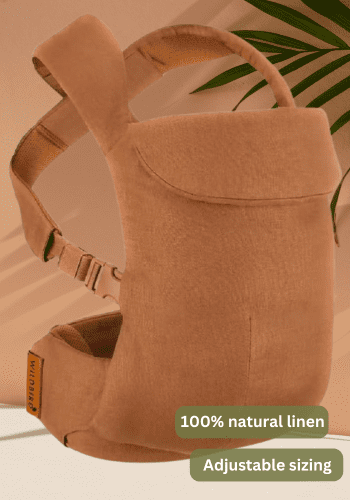
The panel is woven linen rather than a padded synthetic sandwich, which is the reason it breathes. Lizzie’s baby went in happily at any point in the day, including the warm end of the afternoon.
It also works for dads and caregivers with a longer or broader torso, which is not true of everything here.
Fit across adults is the real argument for it. WildBird sells two genuine sizes, Standard for roughly XS to XL and Large for L to 4XL, and those are two different bodies rather than one body with a strap extender clipped on. The distinction matters more than it sounds. An extender lengthens a strap. It does not change where the waistbelt sits or how wide the shoulder straps are set, and those are what decide whether a carrier is still bearable at thirty minutes. The trade is that you buy this in a size, so if two very differently sized adults need to share one carrier, this is not the pick and number five is.
The stated range is wider than the useful range, and WildBird says so itself. The 7 to 45 lb figure is the federal standard’s band. The company’s own recommendation is narrower: 2 to 24 months, and only once your baby’s mid-ear and airway sit above the top of the panel. For newborns and smaller babies WildBird points you to its Aerial Buckle Wrap instead. Read this as a carrier for the sitting-up-and-looking-around stage, not a day-one carrier, and use the ear line as your test rather than the number on the box – two babies of identical weight can sit very differently in the same panel.
Getting it on, and where the weight lands. Shoulder straps and waistbelt are both padded, and Lizzie’s report is that the load sits on her hips rather than dragging at her shoulders. I have not worn it, so I am not going to tell you how it feels at the thirty-minute mark. That is the one thing a gift recipient’s feedback cannot fully stand in for. The colorways are muted rather than loud, and Sparrow is the one I would choose.
Washing, and the hip-health badge. Linen is machine washable and stores flat, which is the easy half. The other half is a claim you will meet on this and most other carriers here: acknowledged “hip-healthy” by the International Hip Dysplasia Institute. Read the wording carefully, because sellers routinely upgrade it. Plenty of marketplace listings say “certified by the IHDI,” and there is no such certification to hold. The IHDI states plainly that it is not a certifying body, has never safety-tested any product, and does not certify or endorse products; it acknowledges partner companies whose educational mission aligns with its own. Its own position is that no baby carrier can cause or prevent hip dysplasia, and that what matters is not restricting hip motion. So ignore the badge and check the seat instead: wide enough to support your baby thigh to thigh, knees higher than the bottom, legs free to move. The Aerial does that. So does every other carrier on this page, badge or no badge.
Buy it if you want one breathable carrier from a couple of months old through toddlerhood, you run warm or live somewhere hot, or standard carriers have never fit you and you need a size that was designed rather than extended. Skip it if you need something from day one, if you want a forward-facing option, or if two very differently sized adults have to share one carrier – you buy this in a size, and that cuts both ways.
The drawback, in proportion: no hood, and no forward-facing carry. The hood matters if you are outdoors a lot, and the fix is a brimmed hat on your baby rather than fabric draped over the carrier. Forward-facing is a preference rather than a need, and it is only usable for a narrow window anyway. Neither is a reason to avoid it. Both are reasons to know what you are buying. Available on Amazon.
2. Best in Budget Baby Carrier: Momcozy PureHug Baby Carrier
Tier 1, owned and used with Sawyer. Manufacturer’s range: 7–45 lb across three sizing stages. Front inward carry, with the seat adjusting through three stages as your baby grows.
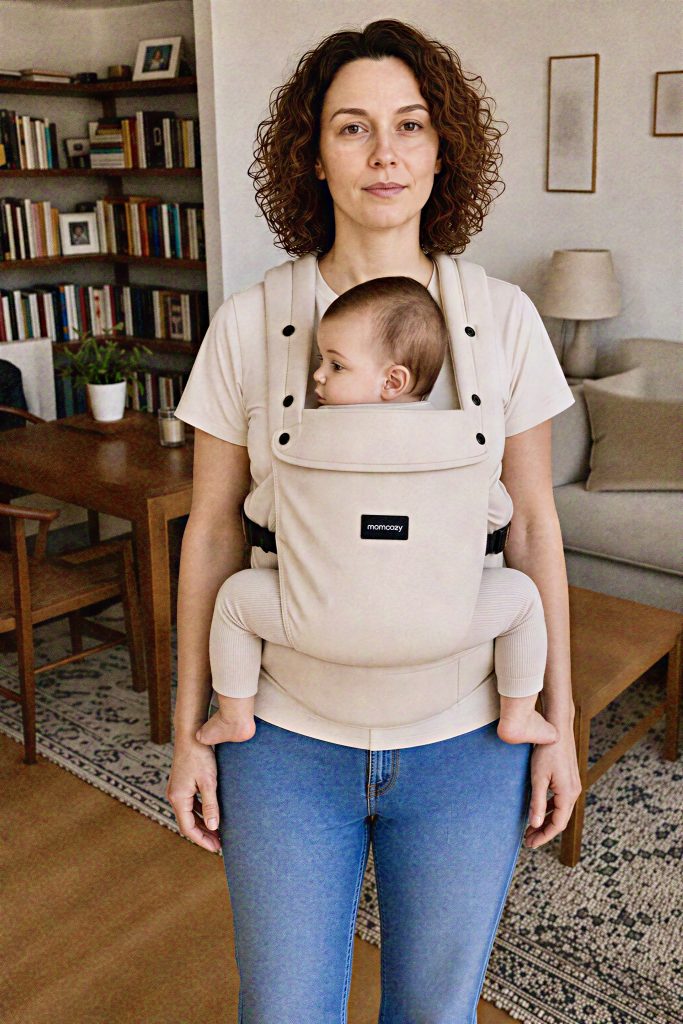
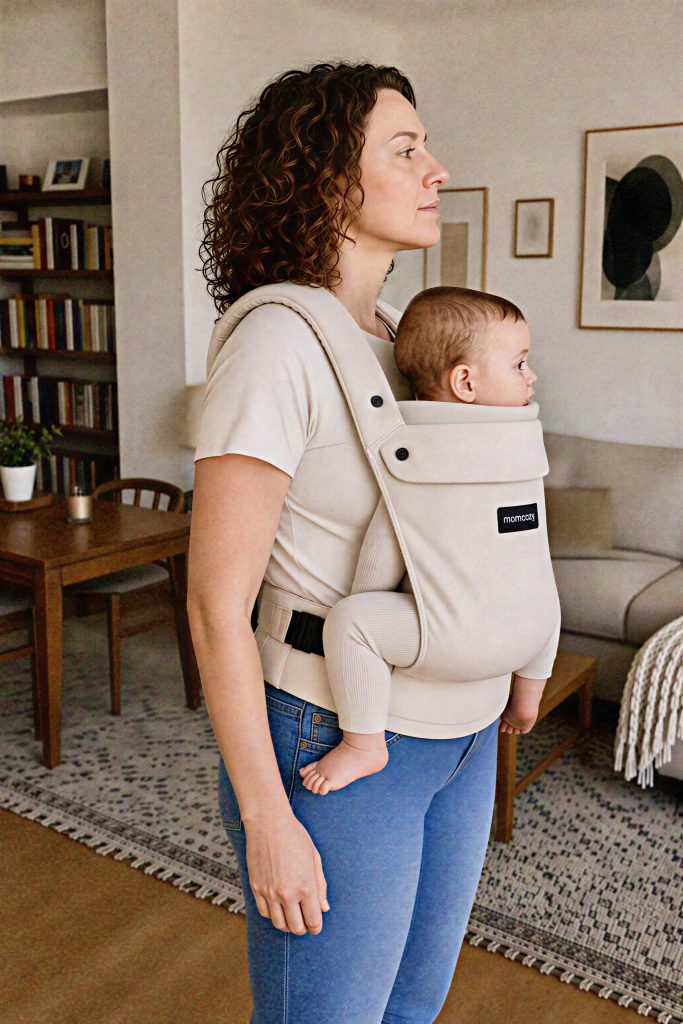
Supportive, light, quick to get on, and under a hundred dollars is a combination that mostly does not exist. Set against the WildBird above, you give up the linen and the two true adult sizes, and you keep almost everything that actually carries the weight. This is the one I point budget-conscious friends to, and none of them have come back disappointed.
One naming note before you click, because the Momcozy line is genuinely confusing and this is the most common way people end up with the wrong thing: the carrier here is the PureHug. Momcozy also sells a separate Newborn Carrier and a WeeSnug, with different weight ranges and different intended stages. Check the listing says PureHug before you buy, then check the range on the label when it arrives.
Momcozy is currently one of the IHDI’s listed industry partners, and the PureHug appears among the products named. As above: a partnership supporting education and advocacy, not a certification and not a safety test. It tells you nothing that looking at the seat does not tell you better.
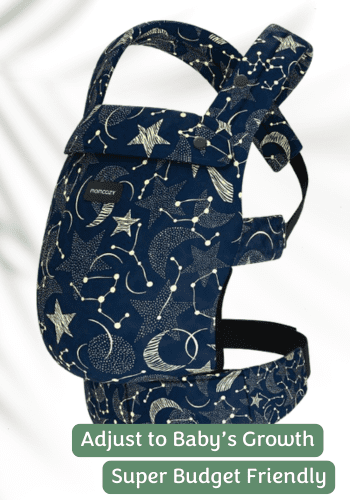
This is not the flashiest or most feature-packed carrier on the market, and that is close to the point. It does the four things from the top of this page properly, which is more than some carriers at three times the price manage.
Who it actually fits. Momcozy rates it 7 to 45 lb across three sizing stages, so on paper it runs newborn through toddler. In practice I would not reach for it in the first weeks, and the reason is structural rather than a matter of taste. A soft structured panel holds its own shape and waits for the baby to fill it, so a very small newborn sits inside the panel rather than being held by it. A stretchy wrap does the opposite and molds to whatever is in it. That is why number three exists on this list. Treat the PureHug as a carrier from roughly the point your baby has steady head control, whatever the lower number says.
Where the weight lands. The EVA waist support is the component doing the real work: it holds the belt’s shape under load instead of folding, so the weight transfers onto the top of your hips rather than sagging into your lower back. That one detail is the difference between a cheap carrier that is fine and a cheap carrier that hurts, and it is what to look for at this price. Lumbar and shoulder padding are both better than the number suggests.
I used this one with Sawyer and she settled in it happily from the first go. I did not record how many months we had it in rotation, so take what follows as everyday use rather than a measured test window.
I got it on by myself on the first attempt, without Terry holding one end, which I cannot say for every wrap I have owned. That is the test I would apply to anything you are considering, and I have set it out properly further down. The cotton softens after a few washes rather than staying board-like, and there is extra padding at the leg openings – which is exactly where a thin carrier leaves red marks on chubby thighs. Support is good once your baby has steady head control and fills the panel out.
Buy it if you want one straightforward soft structured carrier, you do not need four carry positions, and you would rather spend the difference elsewhere. Skip it if you need a newborn-ready carrier for the first weeks, if you want to face your baby outward, or if you will be wearing it through a hot summer – the WildBird’s linen or the Ergobaby’s mesh earns its extra there.
Available on Amazon.
3. Best Budget Pick Baby Wrap: Koala Babycare Baby Wrap Carrier
Tier 1, owned and used. Manufacturer’s range: newborn to 22 lb on the Amazon listing. Worth knowing that Koala’s own site gives the original Cuddle Band a maximum of 9 kg, which is 19.8 lb, and reserves the higher 33 lb figure for the newer Cuddle Band 2.0. Where a brand’s own site and its marketplace listing disagree, use the lower number. Cradle and upright positions; one size fits all adults.
Some babies will not be put down. If that is yours, the specification that matters is not the weight limit. It is how fast you can get the thing on while holding a baby who is already objecting.
The clingy baby. I had a couple of those.
This is where a wrap beats every structured carrier above it: it molds around a small body instead of waiting for the body to fill a panel, and it goes on faster.
My favorite for the clingy stretch has been the Koala Babycare wrap. Stay inside the stated limit even when the fabric still feels as though it has give in it, and here is the mechanism rather than just the rule: stretchy fabric will hold more weight than the seams and rings were tested for, and as it stretches, it sags. Sag drops your baby lower on your body – away from the position where you can see their face without moving anything, and towards the position where their chin can settle onto their chest. The fabric tearing is not the risk. The fabric holding while your baby slides is.
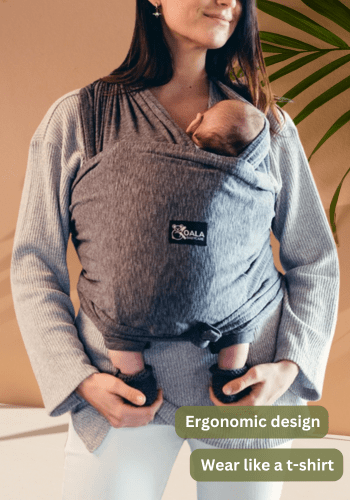
It goes over your head like a T-shirt, then two rings take up the slack. That is the whole method, and it is why this one survives the parking lot. A traditional woven wrap is a long piece of fabric you tie, which means loose ends on wet ground and a technique to remember under pressure. This has nothing to trail and nothing to forget.
It has become the default budget recommendation in my mom group and turns up on a lot of baby shower lists around here. That is popularity rather than evidence, and I am flagging it as such.
The stretch comes from a blended fabric rather than pure cotton, which is what gives it the T-shirt feel and also why it goes slack sooner than a woven wrap. Koala developed the wrap with the Scuola del Portare, an Italian babywearing education organization, and says it can be used from the first days, including in a cradle position for feeding. That is more meaningful third-party involvement than most badges in this category, though it is still design consultation rather than independent safety testing.
The cradle position is the one to be careful with. It is the position CPSC ties directly to infant deaths in slings, because a young baby can curl into a C shape with the chin against the chest and quietly stop being able to breathe. If you use it, keep your baby’s face turned upward and clear of the fabric and of your body rather than turned in toward you, keep the chin off the chest, and check constantly. For anything other than an actively supervised feed, an upright carry with the face visible is the safer default.
Plenty of parents, me included, find that holding a baby upright helps with colic and reflux discomfort. That is a comfort observation, not a treatment, and no carrier is a remedy for reflux. If your baby is in real distress, arching, refusing feeds, or not gaining weight, that is a pediatrician conversation. And whatever helps them settle, a carrier is still not a place to leave a baby sleeping.
Koala designs the wrap for a supported M-position with the knees higher than the bottom, which is the positioning the IHDI describes as leaving the hips free to move. Koala is not among the IHDI’s listed industry partners, so treat that as a design description rather than an outside body’s approval – and note that it makes the earlier point rather neatly. The wrap does the hip-positioning job whether or not anyone has acknowledged it.
The drawback, in proportion: no waistbelt, so the whole load runs through your shoulders and upper back, and it is finished by around 20 lb, which for most babies falls somewhere in the first year. That is not a flaw so much as the category – wraps trade load-spreading and longevity for speed and closeness. It matters if you have back trouble, or if you were hoping one carrier would last two years. It will not matter at all if you buy this for the fourth trimester and move to a structured carrier after, which is what I would do and what most families I know end up doing anyway.
Buy it if you have a newborn, a baby who will not be put down, or you want something that lives in the bottom of a bag and goes on in twenty seconds. Skip it if you are long in the torso and already know that shoulder-only carriers hurt you, if you need it to last past the first year, or if you want a back carry.
Available on Amazon.
4. Best for Travel and Errands: Baby Tula Lite Compact Baby Carrier
There is a specific kind of outing this carrier is built for: the one where you carry for ten minutes, then not at all for an hour, then carry again – and you do not want to be holding a full-size carrier in between. Airports, day trips, and the stage where a toddler alternates between walking and demanding to be picked up.
Tier 3, never worn by me, not obtained. Manufacturer’s range: 12–30 lb, front inward and back carry only. Baby Tula states directly that this carrier is not designed for newborns and typically begins fitting between 4 and 6 months, which depends on your baby’s height as much as their weight. Everything below comes from Tula’s published documentation and from recurring themes across owner reviews, and I say which is which.
The Tula Lite is the one you pack, not the one you live in. Set against the Momcozy above, you trade padding, weight range, and everyday comfort for something that disappears into a bag. It folds into its own waistband pouch, and that is the entire argument for it.
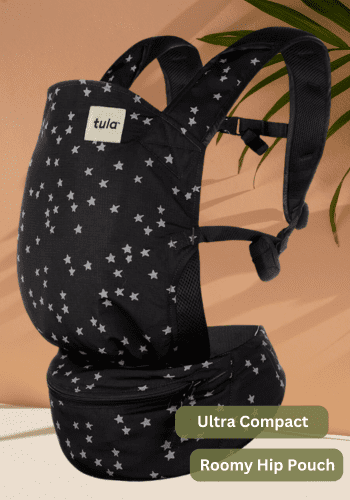
The waistband doubles as the carry pouch, so the carrier packs into a part of itself rather than needing a stuff sack you will lose.
The pouch is not a token gesture, either. Fold the carrier away and it lives in the waistband; wear the carrier and the same pocket holds up to about 3 lb of your things.
Enough for the things you are always digging for at the worst possible moment: keys, phone, a spare pacifier, a pair of mittens. On a plane or a short day out that is the difference between taking a diaper bag and not taking one, which is a bigger difference than it sounds when you are also holding a child.
Where the weight lands, and this is the honest limitation. The whole design is quick-drying ripstop nylon and thin mesh padding instead of thick foam, so it weighs almost nothing and packs down small. The same decision leaves less material between the straps and your shoulders. Across owner reviews the pattern runs consistently in both directions: praise for the weight and the packed size, with the straps as the most common complaint. I have not worn it, so I cannot tell you at what point that becomes uncomfortable or for whom, and I am not going to pretend otherwise. Read it as a carrier for stretches measured in minutes rather than hours.
The Tula Lite is not a newborn carrier, and the Tula Infant Insert does not work with it. If you need something from birth, buy from higher up this list.
The most important thing about this carrier is who it is not for. Baby Tula is explicit that the Lite is not designed for newborns: the minimum is 12 lb, and your child needs to sit in the panel supported knee to knee without their legs being overextended, which usually happens somewhere between 4 and 6 months. Because the panel is a fixed size, it also runs out earlier than Tula’s adjustable carriers, at 30 lb or roughly 18 months. If you want one Tula that starts at birth, the Explore and Free-to-Grow cover 7–45 lb instead.
One correction worth flagging, because it circulates widely and gets repeated in roundups: the Baby Tula Infant Insert is not compatible with the Lite. Tula’s own help documentation says the Lite is not designed to be used with the Infant Insert, or with any external item meant to let a baby who does not yet fit be carried in it. The insert works with their full-size Standard carrier. If you are shopping for a newborn and planned to bridge the gap with an insert, this is not the carrier to do it with, and no padding improvised at home makes it one.
Buy it if you already have a main carrier and want a second one that lives in a bag, or you are traveling with a child over 12 lb who walks half the time. Skip it if this would be your only carrier, if your baby is under 12 lb or under about four months, if you want forward-facing, or if you routinely carry for an hour at a stretch – the padding is not built for it, and owners say so.
Available on Amazon.
5. Best for Support: Ergobaby Omni 360 All-Position Baby Carrier
Tier 1, owned and used with Sawyer. Manufacturer’s range: 7–45 lb, 0–48 months, four carry positions. Facing in, facing out, hip, and back, with no infant insert required at any point.
If the Tula Lite’s two positions and 12 lb floor rule it out for you, the Ergobaby Omni 360 is the one that covers everything the Lite does not.
It does four carries from 7 lb through 45 lb without needing an insert, which is the widest span here and the reason it costs what it does. The no-insert part is worth pausing on, because it is a genuine practical difference rather than a marketing line. An insert is a separate piece of padding you have to remember, store, fit correctly, and eventually stop using at the right moment. Carriers that build the newborn support into the panel remove a step you can get wrong.
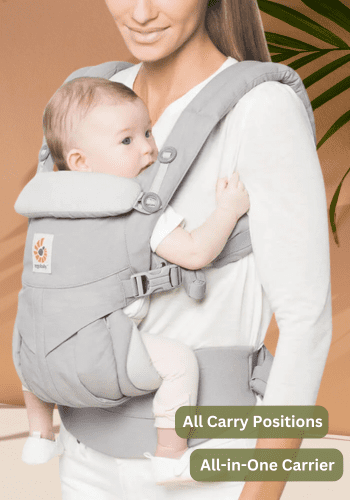
Where the weight lands. What I noticed carrying Sawyer was how evenly it sat. The padded lumbar waistbelt does the job that thin-strapped carriers push up onto your shoulders, and you feel the difference at around the twenty-minute mark rather than immediately – which is exactly why a quick try-on in a shop tells you so little.
The crossable shoulder straps matter once you are hauling a heavy baby or a toddler, because crossing them pulls the load inward and off the tops of your shoulders. The trade is that crossed straps take longer to arrange and are harder to undo one-handed, so they are worth it for a long walk and a nuisance for a dash into a shop. Sawyer would settle in it happily for long stretches. Long stretches meaning awake stretches: if she nodded off, she came out and went down flat, for reasons covered at the top of this page.
The built-in headrest folds up to support a newborn’s head and neck, and the cotton is soft against new skin. One caveat that applies to every upright carrier, not just this one: the AAP advises that babies born prematurely or with respiratory problems should not be put in upright positioning devices, because the position can make breathing harder. Check with your pediatrician before using any carrier with a preemie.
Large button adjusters switch the seat between inward and outward mode, so you are not re-threading straps one-handed. The tuck-away hood is UPF 50+ for sun and wind, and doubles as a privacy cover for feeding. On facing out: Ergobaby’s own guidance is to wait for strong head and neck control, usually around four to six months, and to keep outward sessions to roughly 10 to 20 minutes at first, turning your baby back inward when they tire, look away, or fall asleep.
It is machine washable, breathable, and light enough to sling over a stroller handle. Ergobaby is a current IHDI industry partner, which as covered above means a shared education effort rather than a certification.
The drawback, in proportion: the high back clip and the price. The clip is the one that could genuinely rule it out for you, and it is testable in thirty seconds – reach behind your neck as if fastening a bra strap at shoulder-blade height. If that is uncomfortable, you will be asking for help every time, and the WildBird or the Momcozy will suit you better. The price stings up front and looks different spread across four years of use, particularly with Everlove at the end. Neither is a reason to avoid it if you can do the clip.
Buy it if you want one carrier for the whole run from newborn to preschooler, two differently sized adults will be sharing it, or you want the hip and back carries as well as the front. Skip it if reaching behind your own neck is awkward, if you want the lightest thing to travel with, or if you know you only need a carrier for the first few months – in which case a wrap does that job better for a quarter of the money.
Available on Amazon.
6. Best with Hip Seat: Bear 6-in-1 Baby Carrier with Hip Seat
When your growing baby becomes more active and playful, starting to sit or walk independently, you often find yourself lifting and carrying them as needed.
Tier 1, owned and used with Fiona from just after her first birthday. Manufacturer’s range: 7–44 lb, 3–36 months, three configurations and six carrying positions. I did not track the total months, but it covered the stretch when she was walking and being carried in roughly equal measure.
That is the stage a hip seat earns its place, and the Bear 6-in-1 is the cheapest one I would actually recommend. The rigid seat takes your toddler’s weight on a shelf at your hip instead of on your forearm, which is the difference between a ten-minute errand and an hour-long one. Against everything above it, this is not a better carrier – it is a different tool. The Ergobaby is what you wear for a walk. This is what you wear when your toddler will be down and up twelve times before you reach the car.
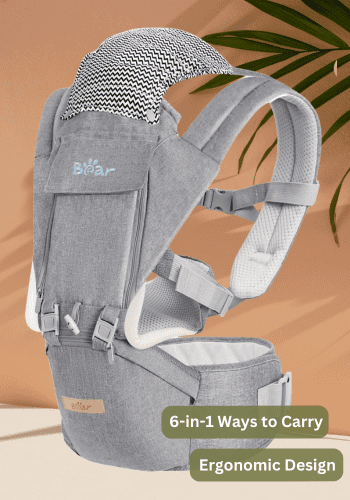
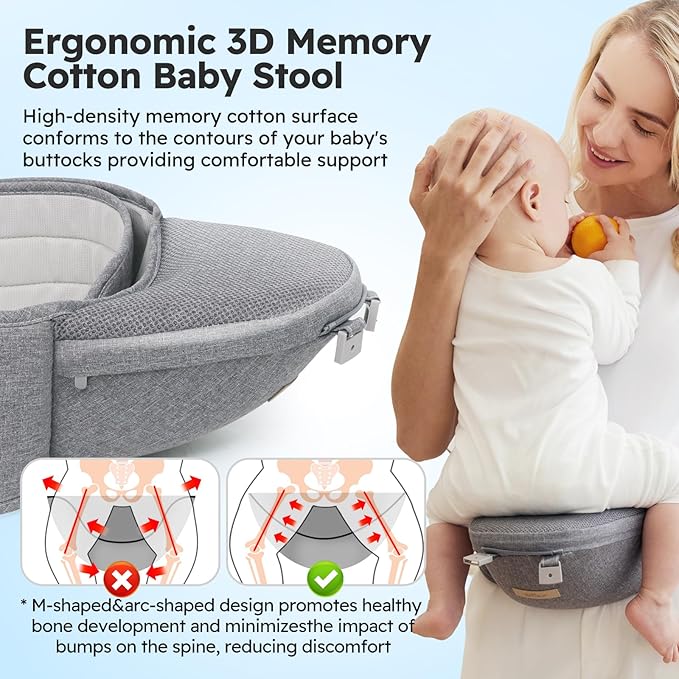
Who it actually fits. Bear rates it 3 to 36 months and 7 to 44 lb, and the seat is a memory foam block under a cotton cover with a non-slip surface. The useful range is narrower than the stated one at both ends. A three-month-old does not need a hip seat and cannot sit on one unsupported; the shelf only starts making sense once your child has real trunk control and opinions about getting down. Follow the maker’s staged instructions for which configuration to use at which age rather than treating all six positions as available from day one.
The anti-slip surface earns its place: without it a toddler in slippery leggings gradually works their way towards the edge of the shelf, and you spend the whole errand hitching them back up.
The sloped seat is shaped to hold your baby’s legs in the M position, knees higher than bottom, rather than letting them dangle. That matters more with hip seats than with fabric carriers: a narrow, flat shelf leaves the legs hanging straight down and the whole weight on the crotch. Whichever hip seat you buy, look for a wide, angled seat and follow the maker’s staged instructions for which configuration goes with which age.
I used this carrier with Fiona after she turned 1. She was at that stage where she wanted me to carry her all the time but also wanted to explore everything around her. This carrier was perfect for giving her the freedom to get down and move around whenever she wanted, all while keeping her safe and secure.
The breathable fabric mattered more than I expected in warm weather, because a hip seat presses a toddler against your side rather than your front, and that contact area gets hot.
The detachable design is what I got the most out of. Seat alone for quick ups and downs, seat plus straps for longer carries, straps alone when I wanted less bulk. Three configurations and six positions sounds like marketing, but on a shopping trip with a toddler who wants down every four minutes, that is the actual feature.
The drawback, in proportion, and the one most hip seat listings gloss over: in seat-only mode you still need one arm around your child. It is a shelf that takes the weight, not a harness that holds them. So it does not give you two free hands the way a full carrier does, and it should never be treated as one for a sleeping or unsteady child. That matters enormously if you bought it expecting hands-free, and not at all if you bought it to save your forearm on the school run. The bulk is the other cost: rigid seats do not pack down.
Buy it if your child is at the down-and-up stage, you are doing short repeated carries rather than long walks, or your forearm and lower back are taking the load at the moment. Skip it if you need a newborn carrier, if you need genuinely hands-free carrying, if packing size matters, or if you want the reassurance of a large brand with a long support history.
Available on Amazon.
7. Best for Twins: TwinGo Original Baby Carrier
With twins, everything gets doubled – strollers, car seats, clothes, all of it. Carriers are the one place where buying two is often the wrong answer, because two separate carriers cannot be worn comfortably at once by one adult, and the belts fight each other for the same few inches of hip.
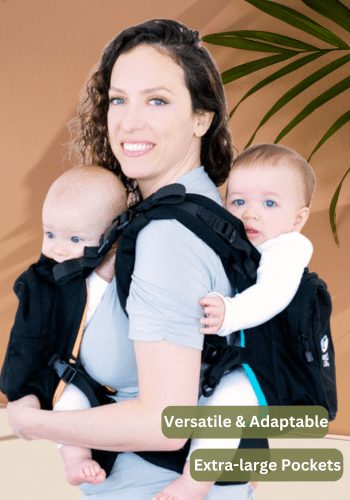
Tier 2, bought by me as a baby shower gift. Not worn by me. Manufacturer’s range: 10–45 lb per child, or from 7 lb with the separately sold infant insert, with a 70 lb ceiling in tandem. Fits adults 4’11” to 6’5″.
The TwinGo Original solves the problem no single-child carrier does: it is one carrier that splits into two. Each side takes 10 to 45 lb, and both halves adjust across a genuinely wide range of adult sizes, which matters more here than anywhere else on this page – with twins you are far more likely to be handing the carrier back and forth between two adults on the same day.
Split it and two adults each carry one baby. Keep it joined and one adult carries both, one on the chest and one on the back. The number to plan around is the tandem limit: 70 lb combined, not 45 lb each. Two 30 lb toddlers put you over it well before either child hits the single-carrier maximum.
We gave this to Terry’s friend Annie at her baby shower, and after her twin girls arrived it was the thing she kept mentioning. Being able to carry both and still have her hands free changed what her days looked like, and with twins there is a lot to have hands free for. Her account, not mine, so weigh it accordingly.
One safety note that matters specifically for twins, and it is the reason this section is longer than the others. In the CPSC’s review of sling deaths, many of the babies who died were low birth weight twins, born prematurely, or had a breathing illness such as a cold. The agency urges parents of twins, preemies, and babies in fragile health to take extra care and to talk to their pediatrician before using a sling at all. Twins are more likely to arrive early and small, so this is not a remote risk for this group, it is the central one. TwinGo’s own guidance is that the back carry starts from four months, once a baby has strong and consistent head and neck control, and that if there is more than three pounds between your two, the heavier one goes on your back.
The two UPF 50 sleep hoods are removable and fold away, and they support a dozing baby’s head rather than letting it flop back. Keep them clear of the face and keep both babies visible, which takes deliberate effort with two: the one on your back is the one you will forget to check, so build in a habit of checking that baby first rather than last. The extra-large pockets hold enough that you can leave the diaper bag behind.
One instruction from TwinGo that is easy to miss and worth following: if there is a weight difference of 3 lb or more between your two, carry the heavier child on your back. It is a balance point rather than a preference. The load on your front pulls you forward and you compensate by leaning back, and putting the heavier child behind you reduces how much correcting your lower back has to do all day.
At around $215 it is the most expensive pick here, but it replaces two carriers, so per child it lands near the middle of the list.
The drawback, in proportion: the learning curve is real, and it is worse than the others here because you are learning a system rather than a carrier. That is a first-fortnight problem rather than a permanent one, and it is the reason to practice before you need it rather than in a parking lot in the rain. The 70 lb tandem ceiling is the more lasting limit – two 30 lb toddlers put you over it long before either child reaches the 45 lb single figure, and no amount of technique changes that.
Buy it if you have twins or two children close in age, you want the option of one adult carrying both, and two differently sized adults will be sharing it. Skip it if your twins were born early or are low birth weight and you have not yet had that conversation with your pediatrician, if you only ever need to carry one child at a time, or if your two are already approaching 35 lb each – at that point the tandem limit is behind you and a double stroller is the honest answer.
Available on Amazon.
8. Best for Toddlers and Back Carrying: Beco Baby Carrier
After Aiden turned 8 months old, we started going out on nature walks and hikes as a family. It was the perfect way for our little ones to bond with nature and each other! I’d carry Aiden in my trusty Deuter backpack carrier while little Avery walked beside Terry. As a mom of six, I can confidently say that these breezy nature walks helped the kids connect with the world around them, and they created memories that’ll last a lifetime.
Tier 3, never worn by me, not obtained. Manufacturer’s range: 20–60 lb, roughly 18 to 48 months. Front inward and back carry. What follows comes from Beco’s published specifications and from the pattern of owner reports, not from my own use, and I have kept the comfort claims out of the first person because I have no standing to make them.
An important distinction first, because the words get used interchangeably and they should not be. The Beco Toddler is a soft structured carrier that can be worn backpack-style. It is not a framed hiking pack like the Deuter above. Framed child carriers have their own federal standard, 16 CFR part 1230, which incorporates ASTM F2549; soft carriers like this one fall under 16 CFR part 1226 and ASTM F2236. For a serious trail day with a heavy toddler, a framed pack with a proper hip belt, kickstand, and sunshade is the right tool. For city walking, travel, and the shorter trail, a soft toddler carrier like this is lighter, cheaper, and packs down.
Within that narrower job – city walking, errands, short and easy trails with a child too heavy for the carriers above – the Beco Toddler is a stripped-back, well-made option, and it starts roughly where the Ergobaby’s 45 lb ceiling ends.
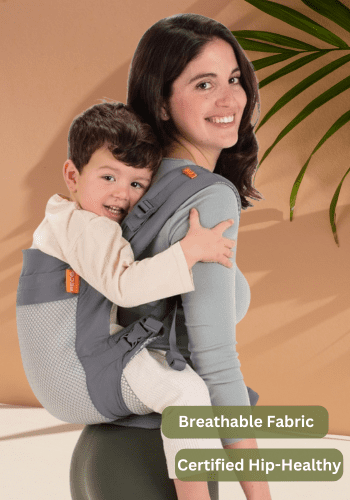
It is 100% cotton, with padded shoulder straps and leg openings, an extra-wide seat, a high back panel that conforms to your child’s back, and a waist belt that moves most of the load onto your hips and legs.
The straps convert between an H and an X configuration to suit different torsos and shoulder widths. Two carry positions: front inward and back.
The detachable hood works as a sunshade, and there is a zippered clutch plus a pocket for keys and cards. On comfort I am going to leave a gap rather than fill it: I have not worn this carrier, and I do not have a specific, detailed account from someone who has. Owner reviews are broadly positive about the width of the seat and the back panel for older toddlers. That is the range of reported experience, not a measurement, and it is not a substitute for trying it inside a return window with your own child’s weight in it.
The 3D mesh version adds ventilation, which cuts down on the sweaty-back problem on warm days. The range that makes it useful is 20 to 60 lb, roughly 18 months to four years – well past the point most soft carriers give up, which is the real argument for it.
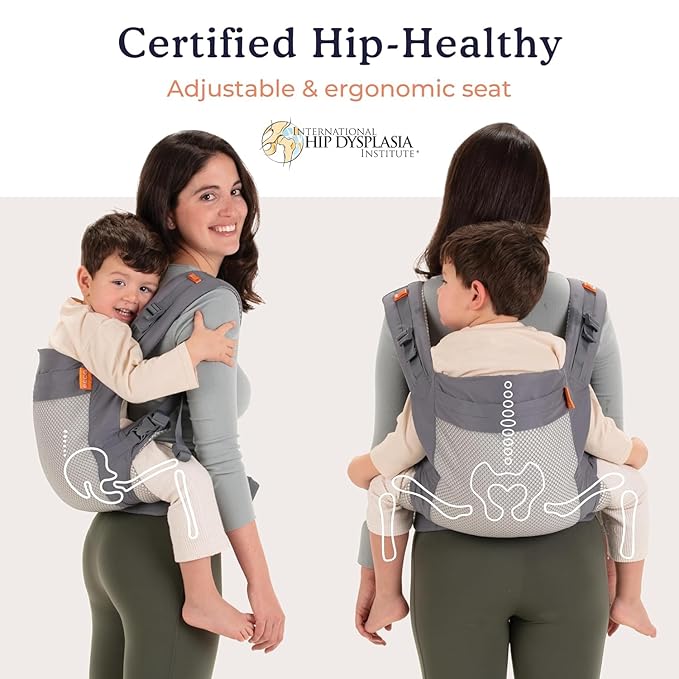
Beco describes its carriers as hip-healthy. As with the others, that is the brand’s own wording: the IHDI does not certify or endorse products, and Beco was not among the industry partners listed on the IHDI’s page when I checked in August 2026. What you can check yourself is the thing that actually matters, which is that the seat is wide enough to support your child from knee to knee with the knees sitting higher than the bottom. On this carrier it is.
The drawback, in proportion: the 20 lb floor makes it useless for a year and a half, and it is not a framed hiking pack however backpack-like it looks. If what you actually want is a full trail day with a heavy toddler, no soft carrier is the right purchase and you should be looking at a framed pack with a hip belt, kickstand, and sunshade. If what you want is to carry a three-year-old around a zoo, that objection does not apply to you at all.
Buy it if your child is over 20 lb and has outgrown a standard carrier, you want a back carry for city walking and easy trails, and you would rather not spend framed-pack money. Skip it if your child is under 20 lb or under about 18 months, if you want one carrier that starts at birth, if you need it to pack small, or if you are planning genuine hiking – and note that this is the one pick on the page where I cannot tell you how the straps feel after an hour, which for a toddler carrier is the question that matters most. Try it inside a return window. Available on Amazon.
Different Types of Baby Carriers
Before you decide, it helps to know the five basic types, because they are regulated differently and they suit very different stages. Wraps and ring slings are legally sling carriers, covered by 16 CFR part 1228 and ASTM F2907. Soft structured and hip seat carriers fall under 16 CFR part 1226 and ASTM F2236. Framed hiking packs are separate again, under 16 CFR part 1230 and ASTM F2549. Any carrier sold new in the US should meet the standard for its category.
These are useful for any adult in the family, not only mothers. If anything I push carriers harder on fathers, grandparents, and anyone else doing the carrying, because they are usually the ones who get handed the baby without also being handed the equipment that makes it comfortable.
1. Baby Wraps
A long piece of fabric you tie around yourself. Stretchy jersey wraps suit the newborn stage best, because the fabric molds around a small body in a way a structured panel cannot, and they hold your baby high and skin-close.
Wraps demand the most attention to positioning of any carrier type. Loose fabric lets a baby slump, which closes the airway; too much fabric over the face does the same thing faster. Tie it snug, keep your baby high enough to kiss, and keep their face uncovered and visible without you having to open anything up.
Woven wraps are sturdier and better for bigger babies and colder weather; the ready-to-wear T-shirt style ones are far quicker to put on but go slack sooner. After a lot of wraps across six kids, that is the trade I kept running into: speed versus how long the fabric holds its shape. If your baby was premature or has any breathing problem, talk to your pediatrician before using a wrap at all.
2. Ring Slings
A single shoulder sling adjusted through two rings. Fast to put on, easy to nurse in, and easy to take off a sleeping baby – which is why I reached for one outdoors more than anything else. The trade is that all the weight sits on one shoulder, so it suits shorter carries.
I always preferred ring slings for breastfeeding, especially out of the house.
Two rules matter here more than anywhere else. First, ASTM’s 2024 update to the soft carrier standard added a required warning about exactly this: after nursing, reposition your baby so their face is not pressed against your body, because a face pressed into you can suffocate them. Second, if you use a cradle carry, your baby’s bottom goes in the deepest part of the sling so it cannot fold them in half, their face turns upward and away from your body rather than in toward it, and you check on them constantly.
3. Front-facing Carriers
Carriers that let your baby ride facing out at the world. The readiness test is developmental, not a birthday: strong, steady head and neck control plus enough trunk control to sit supported, which usually lands somewhere around five to six months. Your baby also has to be tall enough that their face clears the top of the panel.
Keep the sessions short, especially at the start. Ergobaby suggests roughly 10 to 20 minutes at a time. Facing out gives a baby no way to turn away from a busy street or a loud shop, so watch for the signs they have had enough – zoning out, arching, fussing – and turn them back in. A baby who has fallen asleep should never be left facing out, because there is nothing to support their head and their chin can drop onto their chest.
Theo was the one who really wanted this position.
I’d say out of all my kids, he was the one always up & ready for a walk. He loved to sit in the front-facing position and enjoy the view- appreciating the changing seasons.
He is now the one who gets us all outdoors. I would love to tell you the carrier did that, but a baby who liked looking at things grew into a child who likes looking at things, and I cannot separate the two.
4. Convertible Carriers
You may have heard of 2-in-1, 3-in-1, 4-in-1, or 5-in-1 carriers. Such carriers offer changes for sitting and leg space as the baby grows.
You can carry your baby in a facing-in folded seat, a facing-in expanded seat, a facing-out folded seat, a back-carry expanded seat, a slanting seat for breastfeeding, etc. positions.
I know, a bit confusing- I got you; check the image below:
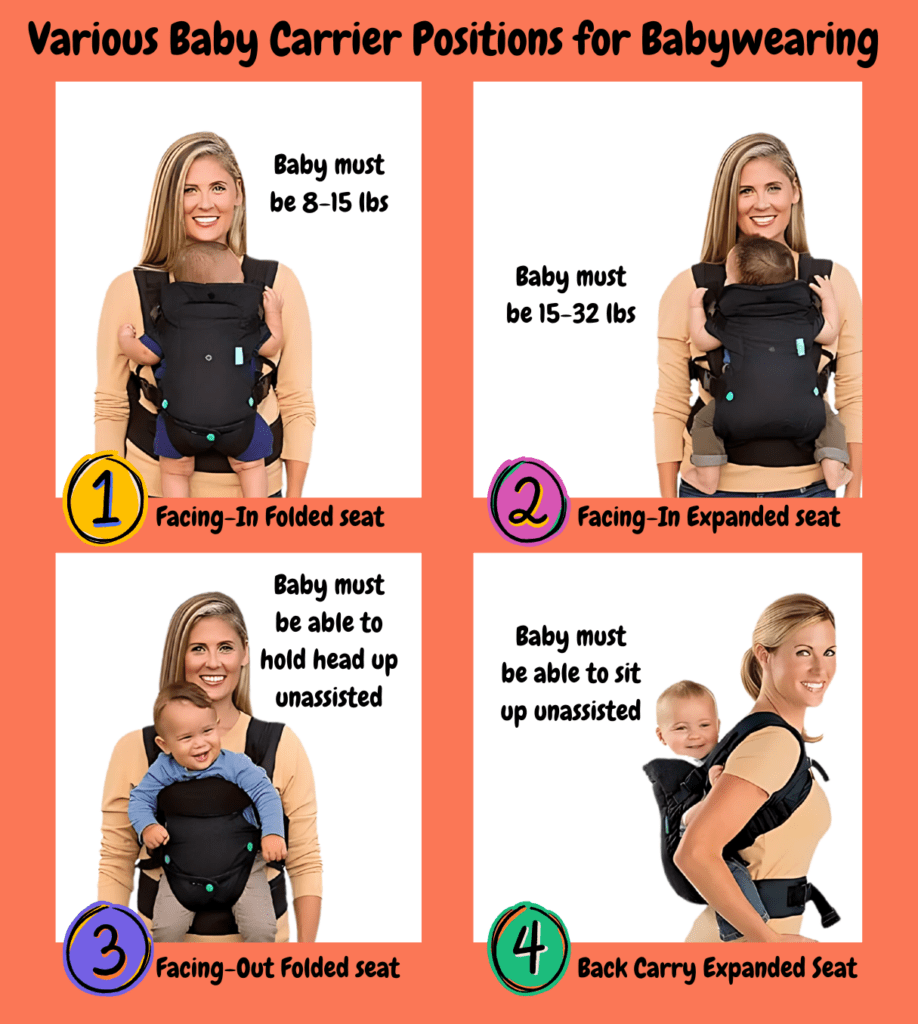
I used the Infantino 4-in-1 Convertible Carrier with Sawyer when she was younger, and its different carrying positions gave us more flexibility as she grew. She was the most active, jittery baby and needed different positions in the carrier to move her arms and legs. I could not keep her down, so I needed a carrier that allowed me to change her positions and engage her conveniently.
5. Hip Seats
A padded, rigid shelf on a waist belt, sometimes with a fabric panel that clips on above it. These come into their own at the up-down-up-down stage, when your toddler wants to walk for ninety seconds and then be carried again. The catch is that they are more hands-on than a full carrier: most hip seat carries still need one arm around your child. Look for a wide, angled seat that supports the thighs rather than a narrow flat shelf that leaves the legs dangling, and follow the maker’s staged instructions for which configuration suits which age.
Benefits of Using a Baby Carrier (and What the Evidence Actually Says)
1. Less Pressure on the Back of the Head:
Plagiocephaly is the clinical name for a flat spot on a baby’s head.
It comes from steady pressure on the same spot while a baby’s skull is still soft. Back sleeping is not the thing to change – babies sleep safest on their backs, full stop – so the fix is what happens while they are awake: supervised tummy time, varying which way their head turns, and cutting down the hours spent lying against a hard surface in a car seat, swing, or bouncer.
That last point is where a carrier helps. Time spent upright against you is time not spent with the back of the head pressed into something. It is one of several ways to get that time, alongside tummy time and just holding your baby.
Sawyer was diagnosed with a flat spot at two months, and I took it seriously. I want to correct something I used to do and used to recommend, though, because I got it wrong: I used to let her nap in the carrier during the day to keep her off the back of her head. That is not safe, and I would not tell another mother to do it now. The AAP does not recommend carriers, slings, car seats, or swings for routine sleep, because a sleeping baby in a seated or curled position can drop their chin to their chest and block their own airway. Carry your baby upright while they are awake, and move them to a firm, flat surface on their back when they fall asleep.
What did work for Sawyer was the boring combination: a lot more supervised tummy time, repositioning her head in the crib, and more time held upright. Her head rounded out. Most cases do resolve with repositioning, but get any flat spot looked at by your pediatrician rather than diagnosing it yourself, since a stiff neck on one side is often the underlying cause and needs treating in its own right.
2. Easier Days in the Postpartum Fog:
Postpartum depression is real, I have been there myself, and it is not talked about enough.
Using a carrier helped me stay close to my kids while also being able to do things for myself, make coffee, eat food.
Skin contact and close carrying are genuinely soothing for most of us, and getting out of the house with a settled baby beats being stuck at home with an unsettled one. I felt calmer when I could be with my baby and still get something done. I want to be careful with the claim, though: a carrier is not a treatment for postpartum depression. If you are struggling for more than a couple of weeks, or you cannot get out from under it, please talk to your doctor or midwife. It is common, it is treatable, and it is not something to carry your way out of alone.
Closeness and getting out of the house help with the isolation of those early months. That is worth having on its own terms, and it is not the same thing as treatment.
3. Calms Baby:
For nine months, babies are safely nestled in the womb, completely secure and supported. So, when it’s time to enter the world, it can be quite a task for them to adjust to this new, open environment.
This was my mother-in-law’s advice, and there is research behind it, though it is older and narrower than the way it usually gets quoted. In a randomized controlled trial of 99 mother-infant pairs published in Pediatrics in 1986, Hunziker and Barr found that babies whose parents carried them more cried and fussed 43% less at six weeks, the peak of the crying curve, and 51% less during the evening. Two caveats that matter. It tested extra carrying in general, not a particular carrier. And when St James-Roberts and colleagues later tried supplementary carrying with babies who were already crying a great deal, it did not prevent the persistent crying, so treat it as real but modest rather than a cure for colic. The AAP recommends babywearing not only to stop crying but to head it off, and to support bonding.
Recommended Reading: How to Swaddle a Newborn
Close carrying also helps a newborn hold their temperature steady, which is one of the reasons skin-to-skin is encouraged in the early weeks.
One myth to clear up while we are here: carrier time is not tummy time. Tummy time means your baby lying on their front on a firm, flat surface while awake and supervised, working the neck, shoulder, and arm muscles against gravity. A carrier holds them upright and supported, which is useful for other reasons but does not build the same strength. You need both. As for reflux and gas, upright holding after a feed is comfortable for a lot of babies, but a carrier does not treat reflux, and persistent symptoms are worth a pediatrician visit.
A snug carrier holds a baby much the way your arms do, which is often exactly what a crying baby wants. Use it for that. Just keep checking the face during a long crying stretch, because a distressed baby wriggles into positions you did not put them in.
4. Promotes Breastfeeding:
Plenty of us feed in a carrier, and a well-fitted carrier makes it easier to do discreetly with your hands free. Many carriers include a hood you can use as a cover.
There is one rule here that is not optional. When the CPSC updated the federal soft carrier standard in 2024 to ASTM F2236-24, it added a required warning for exactly this situation: after nursing, reposition your baby so their face is not pressed against your body. A face pressed into you can suffocate a baby. Lower them to feed if you need to, then bring them back up high, face clear and visible, chin off the chest. Do not let them stay in the feeding position and drift off there.
I would just put on a muslin cloth, but all my babies preferred not being covered. It was one of those things where you just have to go with their preferences, right?
5. Encourage Learning for the Baby:
Babies learn to respond to their caregivers through closeness and repetition.
Carriers act as a bridge to fill that gap between parent and child. Newborns feel safe with skin-to-skin contact when wrapped in a carrier. My husband gave all our kids skin to skin with a carrier while he helped me around the home; it was productive and strengthened his fatherly instincts.
Babies above 6 months old can understand what their mom or dad is doing. They observe and learn motor activities or eventually imbibe and imitate the house activities as they grow into toddlers.
Being at your eye level and in on the conversation is genuinely different from watching from a bouncer across the room, and the AAP notes that babywearing supports attachment and development. I would not promise it turns anyone into a cook or a hiker – that is a nice story, not a finding.
One thing to rule out, though: do not cook at the stove with your baby in a carrier. Steam, splashes, and hot pan handles are all right at your baby’s level, and you cannot see what is under the panel. The general rule from the CPSC is not to do anything while babywearing that you would not do with your baby in your arms. Chop vegetables with them on, by all means. Drain pasta after they are down.
Children copy what they see you do, which is an argument for having them near you while you do it – and a reason to be deliberate about what you are doing while they are strapped to your chest.
How To Choose a Good Baby Carrier? 5 Factors that Every Mom Should Consider!
I bought my first carrier because it looked good, which is a bad reason that happened to work out. What I actually got from it was the ability to leave the house.
From my experience raising 6 kids, one thing I must tell you is that every baby responds differently to a baby carrier. One may settle comfortably into a particular design, while another may become restless because of differences in fit, fabric, support, or positioning (I’ve been there myself).
It is not as daunting as it seems. Work through these five in order, and start with the two that are hardest to fix later: does it match your baby’s current stage, and does it fit the adults who will wear it.
Before any of that, three checks that take two minutes each. Confirm your baby is inside the stated weight and age range for the carrier, not near the edges of it. Search the CPSC recall list for the brand, which matters most for cheap marketplace listings and anything bought second-hand. And check the return window, because fit is the one thing you cannot judge from a photograph.
1. Comfort:
Your baby’s comfort decides whether any of the rest matters. Picture arriving at the park and discovering your little one will not tolerate the carrier you just bought.
It happens more often than the reviews suggest.
Many moms follow the traditional muslin cloth wrapping for their newborns. They are the most comfortable, breathable, and soft to the baby’s delicate skin.
Snug is not the same as tight. A carrier should hold your baby firmly against you with no slack for them to slump into, while leaving their arms free to move and their airway completely clear. On your side, the weight should land on your hips through a padded waistbelt rather than hanging off your shoulders. If your lower back aches after twenty minutes, the waistbelt is sitting wrong or the carrier does not fit you.
The features I would actually pay for, in order: a padded waistbelt, a seat wide enough to support your baby knee to knee, breathable fabric or mesh panels, and adjustable straps that fit both parents. Hoods and pockets are nice. Neck pillows and extra padding are not worth much if the seat and the belt are wrong.
2. Cost:
I will be honest with you; it’s not that deep. We need to understand that some good companies in the mid-price range do provide an optimum feel and features almost like expensive ones.
For example, I used a Tula Explore Linen carrier (a 200 USD carrier, gifted by my mom) for my son Theo. It is one of the best carriers available in the market. Yeah, there’s no doubt that it feels and looks luxurious. BUT-
Later, I got the Infantino Flip Advanced 4-in-1 carrier (costs around 40 USD), which, I felt, was more useful due to its multiple features. Theo was also quite cozy in this one.
So, both were a great choice, but I do prefer my TULA now-over the years it has lasted me longer & still looks pretty good. I would say if you are on a budget, don’t be afraid of buying an economical option, but if you can spend, go for the good quality, aesthetic one because you will get tired of something ugly over time.
Work out your cost per month of use rather than the sticker price. A $180 carrier you wear from three months to three years is cheaper per month than a $45 one you outgrow at nine months and replace. Ergobaby’s Everlove buyback also returns some value at the end, which narrows the gap further.
3. Structure:
ERGONOMIC AND CONVERTIBLE!
These two words flash in my mind for the carrier’s structure. It must be ergonomic to carry a baby with multiple features like –
- front and back sitting,
- feeding position availability,
- proper thigh, waist, and back support,
- belt-size adjustable options (helps when baby grows)
- comfortable M-leg position
- breathable mesh to avoid sweating, rashes, and overheating for baby.
I am saying this because each baby has different needs and preferences.
And they grow fast – most babies double their birth weight by around five months.
Very few carriers genuinely span newborn to toddler. Most families end up with two: something soft for the fourth trimester, then a structured carrier or hip seat from around four to six months. Budget for that from the start instead of hunting for a unicorn.
I have used baby wraps such as the Solly Wrap for Fiona (my sweet girl), ring slings like Sakura Bloom Basics, soft structured carriers like Happy Baby, etc. Each one has had its purpose, depending on the age and needs of my babies.
4. Body fitting:
Terry found several of these too short for his frame – he is taller and broader than me, and the straps ran out before the fit was right.
So we also tried plus-size carriers like Tula Coast Explore, ClevrPlus Cross Country Baby Backpack Carrier (our daughter Fiona likes it very much for hiking trails), etc.
Such heavy-duty carriers are made for big-sized adults and heavy toddlers. They are strong, sturdy, and comfy.
For newborns, plus-size parents can blindly trust ring slings and wraps; as these carriers are the most cozy and give the feel of the mother’s womb to the newborn. I used the Solly Baby Wrap Carrier when Sawyer was born. She loved to sleep in that for hours!
5. Quick on-off wearing:
The carrier you can put on in the rain, in a parking lot, with a screaming baby on your hip, is the carrier you will use. The one that needs a mirror and both hands will sit in the closet. This is the factor most people underrate and then regret.
Three checks, inside your return window, before you cut the tags off. None of them need a baby – a bag of rice or a sack of flour at roughly your baby’s weight works, and doing it without a real baby is the point, because you want to find the problems before they are strapped to you.
1. The parking-lot test. Put the carrier on alone, wearing a coat, with no mirror, in under a minute. Then take it off and do it again. If you had to ask someone for help with a clip, or you needed to see what you were doing, note which part – that is the part you will still be struggling with in six months. The high back clip on a crossable-strap carrier is the usual culprit.
2. The sit-down test. With the weight in it, sit down on a dining chair, then in a car seat, then stand up again. A waistbelt that is comfortable standing can dig into your stomach the moment you fold in the middle, and you will be sitting down constantly – in cars, on benches, on the floor. Check whether you can still reach the buckles once seated.
3. The twenty-minute test. Wear it around the house for twenty minutes with the weight in, and pay attention to where the ache turns up first. Shoulders means the waistbelt is too loose or sitting too low, and it is usually fixable. Lower back means the belt is not holding its shape under the load, which is not fixable. Nowhere in particular means you have found the right one.
Whoever else will be wearing it should repeat all three. A carrier adjusted to fit one parent is not adjusted to fit the other, and the second person tends to discover this at the least convenient moment.
Hybrid carriers like T-shirt carriers, hiking backpack carriers (in case you are an adventure-loving parent), Meh Dai Asian-style soft wrap carriers, etc., will work best for you.
My husband Terry used the wearable Koala baby carrier and the ‘no buckle and no ring’ Original Baby K’tan Baby carrier to carry our kids when they were babies.
Beyond all that, trust what you notice. You will feel a bad fit before you can explain it – and if you cannot explain it, that is still a reason to send it back.
You know your baby better than any list does. Use this one to narrow the field, then let the return window settle it.
The T.I.C.K.S. Rules for Safe Babywearing
This checklist comes from the UK Sling Manufacturers and Retailers Consortium, and it is the one I run through every single time before I take a step. It takes about five seconds and it covers the two things that actually hurt babies in carriers: a blocked airway and a curled chin.
T
Tight
Snug enough to hug baby close. Slack fabric lets them slump, which hinders breathing and pulls on your back.
I
In View
You can see baby’s face by glancing down, without opening the carrier. In a cradle carry the face turns upward, never in toward your body.
C
Close to Kiss
High on your chest: tip your head forward and you should reach their forehead.
K
Keep Chin Off Chest
Never curled with the chin forced onto the chest. Keep at least a finger’s width of space under the chin.
S
Supported Back
Back supported in its natural position, tummy and chest against you. Press gently on their back: they should not uncurl or shift closer.
Baby Carrier FAQs: Safety, Ages, and Fit
Is a baby carrier good for newborns?
Yes, with conditions. Wraps and ring slings suit the newborn stage best because the fabric molds around a small body. Many structured carriers set a minimum of 7 to 12 lb, so check before you buy. Keep your newborn upright and high on your chest, face uncovered and visible, chin off the chest. The CPSC urges extra caution with babies under four months, and the AAP advises that babies born prematurely or with breathing problems should not be put in upright carriers at all without talking to a pediatrician first.
How long can a baby stay in a carrier?
There is no fixed time limit while your baby is awake, comfortable, and correctly positioned. What matters more than the clock is checking often that the face is visible, the chin is off the chest, and nothing is blocking the nose or mouth. Two exceptions: keep outward-facing carries short, around 10 to 20 minutes at first, and do not use a carrier as a routine sleep space. If your baby falls asleep on you, move them to a firm, flat surface on their back as soon as it is safe and practical.
Can my baby sleep in a baby carrier?
Not for routine sleep. The American Academy of Pediatrics does not recommend carriers, slings, car seats, swings, or strollers as sleep spaces, particularly for babies under four months, because a baby who relaxes in a seated or curled position can drop their chin onto their chest and obstruct their own airway. Babies do doze off while being carried, and that is normal. Move them to a firm, flat, non-inclined surface on their back once you safely can.
Is it really necessary to have a baby carrier?
No, it is not necessary, and not every baby or parent takes to one. It is useful. If you have other children, no elevator, a long commute, or a baby who settles best on your body, a carrier buys back both hands and gets you out of the house. If you have a small home, a calm baby, and a stroller you like, you may barely use one. Borrow before you buy if you can.
What makes a baby carrier good?
Four things, in order. A seat wide enough to support your baby from knee to knee with the knees higher than the bottom. A padded waistbelt that moves the weight onto your hips instead of your shoulders. A weight and age range that genuinely matches your baby right now. And a design that keeps the airway clear, with the face visible and the chin off the chest. Breathable fabric, adjustability across both parents, and a hood are worthwhile extras. Any carrier sold new in the US should also meet the federal standard for its category.
When can my baby face forward in a carrier?
Usually around five to six months, but the milestone matters more than the month. Your baby needs strong, steady head and neck control plus enough trunk control to sit supported, and they need to be tall enough that their face clears the top of the panel. Your carrier also has to be rated for outward carrying. Start with short sessions of roughly 10 to 20 minutes, because facing out gives a baby no way to turn away from an overwhelming environment. Turn them back inward when they get fussy, zone out, or fall asleep.
What is the safe position to carry a baby on a hike?
Upright, either facing inward on your front or in a back carry, once your child has strong head, neck, and trunk control. Never in a reclined or curled position on uneven ground. For a genuine trail day with a heavier toddler, a framed hiking carrier with a structured hip belt and sunshade is the right tool; a soft carrier worn backpack-style is better suited to city walking and shorter, easier trails. I have covered baby carrier positions in more detail in a separate article.
At what age can a baby go in a hiking carrier?
For a framed hiking carrier, most manufacturers require that your child can sit unassisted with strong, consistent head and neck control, which is typically around six months at the earliest. Check your specific model’s stated minimum rather than going by age alone, since minimums vary. The AAP advises that babies born prematurely or with respiratory problems should not be placed in backpacks or other upright positioning devices without medical advice.
Are baby carriers regulated for safety in the US?
Yes, and the rules differ by type. Soft structured carriers fall under 16 CFR part 1226, which now incorporates ASTM F2236-24; the CPSC published that update in November 2024 and it took effect on February 22, 2025. Slings and wraps fall under 16 CFR part 1228 and ASTM F2907. Framed hiking carriers fall under 16 CFR part 1230 and ASTM F2549. The 2024 update to the soft carrier standard added a required warning to reposition your baby after nursing so their face is not pressed against your body, which the 2014 version it replaced did not contain. What a standard cannot do is guarantee that every listing you see complies with it, so buy from sellers you can identify and contact, keep the instruction sheet, and check the CPSC recall list before buying anything second-hand.
Do I need an IHDI-certified hip-healthy carrier?
There is no such certification. The International Hip Dysplasia Institute states directly that it is not a certifying body, has never safety-tested any product, and does not endorse products; it partners with some brands on education instead. The IHDI’s own position is that no baby carrier can cause or prevent hip dysplasia, and that products allowing unrestricted hip motion do not cause it. What it does flag as a risk is restricting hip motion, for example through tight swaddling. So ignore the badge and check the carrier: a wide seat supporting your baby thigh to thigh, knees higher than the bottom, and legs free to move.
Baby wrap vs. baby carrier – which one is better?
Neither, they suit different stages. A wrap is better for the newborn months: it molds to a small body, gives the most skin contact, and adjusts to any wearer. A structured carrier is better once your baby has some size and head control: it puts the weight on your hips rather than your shoulders, goes on in seconds, and handles a toddler that a wrap cannot. Most families I know use a wrap first and a structured carrier from around four to six months.
Which Baby Carrier Should You Buy?
Here is the short version, by stage. If you read nothing else on this page, read this and the safety box at the top.
Newborn to about four months: a wrap. The Koala Babycare wrap at around $40 covers it, and I would treat its ceiling as the 9 kg on Koala’s own site rather than the 22 lb on the listing. Structured carriers mostly do not hold a very small baby well, whatever the minimum on the box says. Skip a wrap if you are long in the torso and know that shoulder-only carriers hurt you.
Four months to toddler, one carrier for the whole run: the Ergobaby Omni 360 if you want four positions and the widest 7–45 lb span, or the WildBird Aerial if breathable linen and a size that genuinely fits you matter more. The Momcozy PureHug does most of the same job for a lot less. Skip the Ergobaby if reaching behind your own neck is awkward, and skip the WildBird if two very differently sized adults have to share one carrier.
The up-down-up-down stage: a hip seat, like the Bear 6-in-1, remembering that a hip seat still needs one arm around your child. Travel and errands: the Tula Lite, from 12 lb, as a second carrier rather than your only one. Toddlers and back carrying: the Beco Toddler, from 20 lb, though a framed pack is the right tool for real hiking. Twins: the TwinGo Original, remembering the 70 lb combined tandem limit and the advice to carry the heavier child on your back.
Two things no list can settle for you: whether a carrier fits your body, and whether your particular baby will tolerate it. Both are worth a return window, or a trip to a local sling library where you can try several in an afternoon for nothing. If you only take one habit from this page, make it running the three checks in the section above before the tags come off.
Whichever one you pick, run the T.I.C.K.S. check before you take a step: snug, in view, close enough to kiss, chin off the chest, back supported. And when your baby falls asleep on you, move them to a firm flat surface on their back. Those two habits matter more than anything on this page.