Best High Chairs for Babies 2026—Tested by Mom of 6
If you’re on the hunt for the best high chair for your baby, I know how overwhelming this task can feel. I have 6 kids- YES, I KNOW (it still surprises me some days). I have raised different babies through purées, baby-led weaning, and spaghetti nights that turned into bath nights, and I’ve owned the flimsy chairs, the bulky ones, the wipe-clean unicorns, and a few I wish I’d never assembled. I can tell from far away when a baby product is going to work or not, and that’s what we will talk about today- the right high chair.
I have been through the struggle, and I know all you’re going through right now. Not only that, but I also get the scare of a wrong, erratic move because my son was overly enthusiastic, and there was not a chair in sight that this boy wouldn’t flip while he was sitting on it, by just jumping. So stable and sturdy became a non-negotiable for us.
My fundamental must-haves in a good high chair are easy: safe, extremely stable & sturdy, easy to clean, adjustable height & safe to grow in.
Then comes my list of nice-to-have bonus features: foldable design, removable tray, quality of materials, recline capabilities, harness style (5-point or 3-point), etc.
Across six kids I have lost count of how many chairs have come through this kitchen, because every one of them had a distinct personality- and with that came distinct problems. My eldest daughter was a “plate thrower”- she would take the plate and flip it across, which was so difficult because once I had to cook for her 4 times. I learned my lesson and got her the suction plate to make sure she cannot take the plate out. Also, it gives a bit of exercise, don’t you think?
My absolute favorite that I even gift to my friends at baby showers is the Graco EveryStep 6‑in‑1 because of its versatility and ease of cleaning. It covers six stages, from a reclining infant seat all the way to a kitchen step stool, so for most families it is the one chair that carries you through. Graco rates it to 40 lb in high chair mode, 60 lb as a toddler booster and 75 lb as a step stool.
And for my friends that own a townhouse or a condo, my go-to choice is Stokke Clikk. It’s a very compact yet super stylish chair that is so easy to assemble and put together. It can also be used as a handy travel chair. Very often, I would take this with me along with Theo and Sawyer to places that didn’t have a high chair available. This chair clicks in a snap and the chair itself weighs about 8 lb, which is less than a loaded diaper bag.
But let’s talk in detail about all my top choices in various categories to help you find the best one for your kid.
How to read my recommendations (my evidence tiers)
Plenty of high chair round-ups imply the writer personally wrestled all twelve chairs through a year of spaghetti. I would rather tell you exactly where each claim comes from, so you can weigh it yourself. Every statement in this guide sits in one of five tiers:
- Tier 1 – Manufacturer specs. Weight limits, recline positions, harness type, dimensions, care instructions. Checked against the brand’s own current product page or manual, not a retailer listing. Specs do change between model years, so I note the figure and you should confirm it on the listing you are actually buying.
- Tier 2 – Regulation and medical guidance. The federal high chair rule (16 CFR part 1231), the ASTM standard it references, CPSC recall notices, and the American Academy of Pediatrics. This tier overrides everything else here, including my own opinion.
- Tier 3 – Independent testing and awards. Consumer Reports, BabyGearLab, NAPPA, and the Baby Safety Alliance verification seal. Useful because these groups handle chairs I have not.
- Tier 4 – My own family’s use. Chairs that have actually sat in my kitchen with one of my kids buckled into them. I name the kid and the chair when this applies, and it does not apply to all six picks.
- Tier 5 – Other parents. My mom group, our pediatrician and OT conversations, and reviews. Good for spotting the annoyance that never shows up on a spec sheet. Weakest tier, so I flag it as opinion rather than fact.
Where I have used a chair myself, I say so and name the child. Where I have not, I say that too, and the pick rests on Tiers 1 through 3 instead. Four of the six chairs below have been in my house. Two of them I assessed from specs, independent testing and parent feedback. I would rather lose the sale than pretend otherwise.
In This Guide
6 Best High Chairs for Babies
With six kids of my own, I’ve seen firsthand how differently every baby reacts to baby gear, including high chairs. My son Aiden had the smoothest journey when it came to enjoying meals in his chair. I still remember him giggling through meals in his Graco Blossom high chair. But my daughter Fiona? She refused to sit still. I tried three different high chairs with her before we finally found one that felt comfortable and supportive. Some chairs seemed too tight, while others made her arch her back or wiggle as though she was trying to escape the harness.
However, now having gone through this journey 6 times myself, I’ve come to the realization that it’s just comfort and support that matter more than we parents realize – an adjustable footrest, soft seat, and the right height adjustment made all the difference.
Haha. It feels NOSTALGIC now! If you are a parent, you can understand what I am saying! Kids do have their own choices.
You must go on trying and putting in the effort until your baby finds comfort in the chair seat.
Now most of my kids are grown up, and it’s actually funny – and honestly, it is nostalgic to think about this. If you’re also a baby mama or papa, you know what I mean.
Every baby has their own personality, even when it comes to something as simple as where they eat. And honestly, you just have to keep trying until your little one finds their happy and peaceful spot.
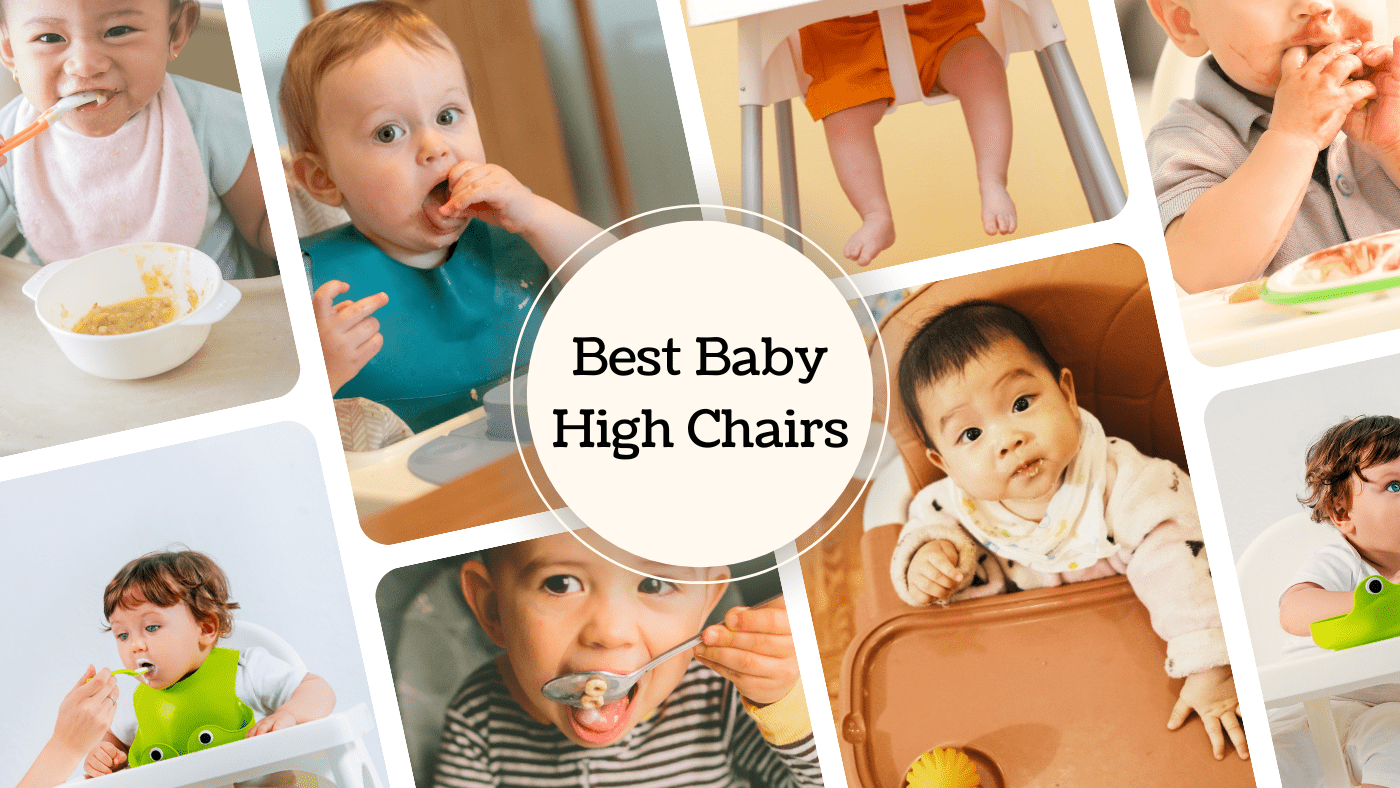
Here are my six picks, sorted by the job you need done rather than by a score out of ten. Four of them have been in my kitchen through real meals, real messes and real tantrums: the Graco EveryStep, the Ingenuity SmartClean Trio, the Stokke Clikk and the Graco Blossom. The Munchkin Float and the Abiie Beyond Junior I have not owned, so I judged those two on manufacturer specs, independent testing and what parents in my circle report. I have flagged which is which on every single pick below.
| Sr. no. | Product Type | Product Name | Typical price |
| 1. | My Top Recommendation | Graco EveryStep 6-in-1 High Chair | $200–$230 |
| 2. | Best in Budget | Ingenuity SmartClean Trio 3-in-1 High Chair | $100–$120 |
| 3. | Best Travel Option | Stokke Clikk High Chair | $150–$190 |
| 4. | Best Space Saving | Munchkin Float Baby High Chair | $150–$170 |
| 5. | Best With Modern Look | Abiie Beyond Junior Wooden High Chair with Tray | $220–$280 |
| 6. | Best Convertible | Graco Blossom 6-in-1 Convertible High Chair | $200–$250 |
Those are ranges, not quotes. High chair prices move constantly with sales and colourway, and list price often sits well above street price. Stokke lists the Clikk at $189 and discounts it regularly, for example. Use the range as a sanity check and click through for the real number.
1. My Top Recommendation: Graco EveryStep 6-in-1 High Chair
If I had to choose one high chair based on its features, versatility, ease of cleaning, and long-term value, the Graco EveryStep 6-in-1 would be my top recommendation.
I bought the Graco EveryStep 6-in-1 chair for my son Theo when he turned 7 months old, and honestly, this chair has grown right alongside him. (He turned 4 this month (Jan 2026)). This has worked miraculously well for all of his mealtimes, from messy puree days to toddler snack time.
Evidence tier 4. This chair lived in my kitchen with Theo, so the hands-on parts below are ours. Every spec is checked against Graco’s current product page.
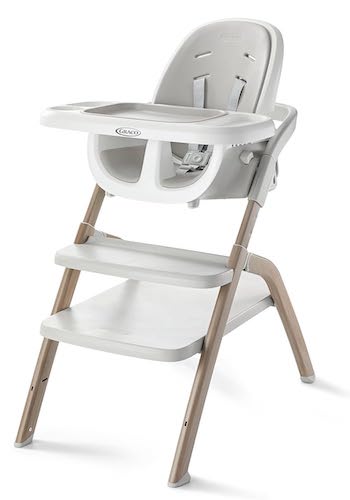
Firstly, it’s super sturdy without being clunky (your girl is not a bodybuilder), folds beautifully (and yes, it stands on its own when folded), and feels solid and durable enough to survive years of spills, crumbs, and curious little climbers.
I’ve tried plenty that were either wobbly or took up almost half of the dining space in the kitchen, but this one, believe me, is perfect, like a match made in heaven, with a perfect balance between form and function.
Now, coming to some other nitty-gritty and useful details like the adjustable footrest and three-position recline, they make a big difference in comfort. And believe me, you do need these, especially during longer mealtimes or early feeding days when babies still need a little support.
And the best part? It’s super easy and simple to clean. Spot cleaning with a damp cloth works like a charm. And lucky for us, the tray insert even pops right into the dishwasher, which is one of those features you don’t realize you need until it saves you after a long day.
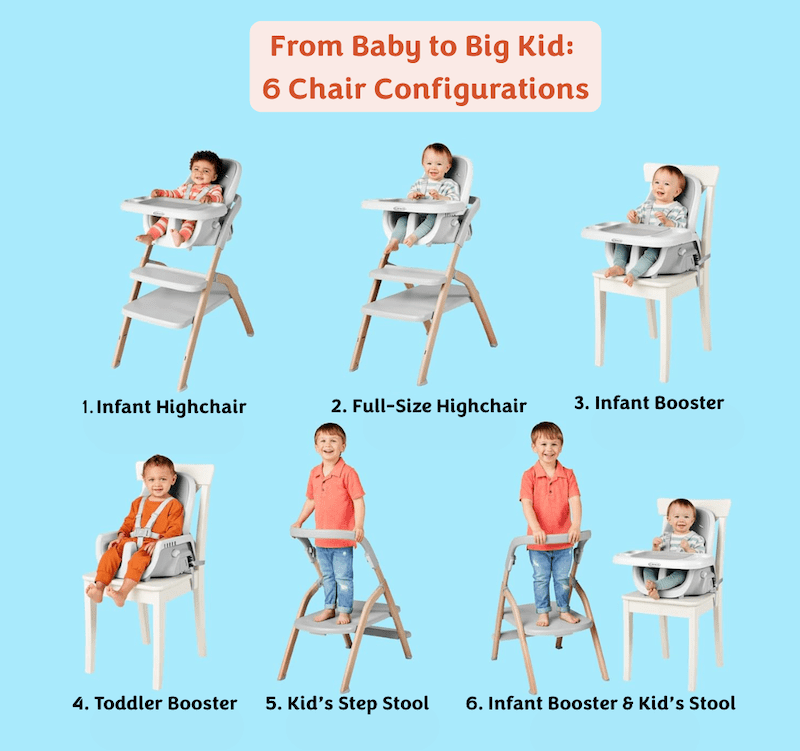
Now you might not be expecting this, but I used this chair beyond mealtimes as well. The design is so versatile, and when Theo started standing on his own, we used this as a mini-stool to help him stand next to the vanity countertops in the bathrooms so he could brush his teeth independently. This chair has 4 height adjustments that you can choose from – so again, very functional design – and your little one can reach and grab just about anything safely and confidently.
And you know what? The design is so compact and easy to carry that sometimes when we are out and about at places and restaurants that don’t have a high chair, we simply fold this one, and carry this in our trunk. The chair is lightweight, highly portable, and, trust me, has made mealtimes a thousand times easier when eating out.
Graco lists it at $229.99 and it usually sells a little under that. That is real money for a high chair, but the numbers carry the argument: 40 lb in high chair mode, 60 lb as a toddler booster, 75 lb as a step stool. Set against buying a separate booster and a separate step stool later, the cost per year of use lands below most cheaper chairs. One practical warning: it goes out of stock at Graco fairly often, so compare a couple of retailers.
Kelleigh’s Final Verdict: the Graco EveryStep 6-in-1 is the chair I recommend most often, and the one I would buy again without hesitating. Buy it if you want a single chair to carry you from first purées to a big kid at the counter, and you would rather not buy a booster and a step stool later. Skip it if your kitchen is tight on space, or if you only need a seat for the next twelve months, because you would be paying for stages you will never use.
It is reliable, quick to wipe down, and it covers every stage from first purées to a big kid standing at the counter. It has earned its permanent spot on my ‘would buy again’ list, which is why it goes to my friends at baby showers. Nobody paid for that placement and nobody sent me one free. Two honest caveats: the harness webbing needs washing every few weeks, and Graco specifies household soap and warm water only on the frame and seat pads, no bleach.
Available on Amazon.
2. Best in Budget: Ingenuity SmartClean Trio 3-in-1 High Chair
Evidence tier 4. Theo used this one as well. When he was ready for a mealtime seat we tried the Ingenuity SmartClean Trio Elite, and for a chair around $100–$120 the feature list won us over.

For a budget chair it does not skimp. It weighs about 19 lb, stands roughly 42 inches tall, and converts three ways: full high chair, chair-top booster, and toddler seat. Kids2 rates it to 50 lb, the highest ceiling of any chair on this list, and in booster plus toddler-seat modes it seats two children at once.
I, personally, used it for Theo for all of his meals, and sometimes, Sawyer used to sit in it to complete her schoolwork.
So, this chair is like ‘two birds with one stone’ for me!
This chair does save real time at cleanup. It assembles without tools, and the BPA-free EasyClean tray is dishwasher safe and detaches with one hand. The tray takes plates up to 19 inches wide and has four locking positions, so it moves closer as your baby’s reach grows. The removable EVA foam insert and the frame both wipe clean, which in practice beats waiting on a wash cycle.
The adjustable 5-point harness has three shoulder heights, so it keeps pace with your baby instead of going slack across the chest. The seat reclines at the push of a button, useful for a bottle before solids begin. Ingenuity’s own manual is blunt on this point and so am I: the harness must be buckled and correctly fitted in the reclined and the upright position, every single time. The white metal legs and neutral grey seat suit most kitchens.
I feel getting such a versatile yet affordable chair that will not be outgrown soon is like a DEALMAKER for you, especially if you have more than 2 kids!
Kelleigh’s Final Verdict: roughly $100–$120 buys three modes, a 50 lb ceiling and a dishwasher-safe tray, the most function per dollar here. Buy it if budget leads and your baby already sits well. Skip it if you want a footrest, because there is none.
Available on Amazon.
3. Best Travel Option: Stokke Clikk High Chair
Evidence tier 4. Sawyer used this one, and it came with us to plenty of restaurants that had no high chair. Lots of chairs claim portability. This is the one I actually carried.
The chair weighs about 8 lb, which is what makes it genuinely portable. The legs are FSC-certified European beech, a solid hardwood rather than engineered board, so it stays light without feeling flimsy. Stokke rates it for 6 to 36 months, or up to 33 lb.
Check the listing carefully on this one. The standard box holds the chair, the tray and the five-point harness. The padded travel bag is a separate Stokke accessory and only some bundles include it, so do not assume it is in the box. The harness lifts out and goes in the washing machine, and Stokke states the materials are free from phthalates.
Setup is the best part. It snaps together in three clicks with no tools, in under a minute, which matters when you are assembling it in a hotel room with a tired baby on your hip. There are three seating configurations and an adjustable footrest, so you can hold the 90-90-90 position as your child grows. It is designed for babies who already sit up unaided.

My girl Sawyer was too active when she was a baby. Initially, I got a high chair from IKEA. But she used to wiggle, slide, and come out of the harness straps easily when kept in that chair.
After doing some research, I found this chair! And it was a BLESSING for me!
The five-point harness and adjustable footrest kept her genuinely seated instead of halfway out. Stokke states the Clikk carries the Baby Safety Alliance verification seal, the programme formerly known as JPMA certification, and meets or exceeds the ASTM standard. That seal is the voluntary mark worth looking for on top of the mandatory federal rule.
The tray detaches and is dishwasher safe, and the chair has almost no seams or crevices, so a damp cloth really does finish the job. That is the biggest day-to-day difference between this and a chair with a padded fabric seat.
Its comfy cushion helps babies to sit upright with back and side support during the initial phase. If your baby needs more cushioning and comfort while sitting in this chair, you can get this Stokke Clikk Cushion (only $39)!
Kelleigh’s Final Verdict: Stokke lists the Clikk at $189 and discounts it often, so it competes with mid-range chairs rather than luxury ones. The 8 lb weight and one-minute setup earn the money if you travel, eat out, or live somewhere tight on floor space. If the chair never leaves your kitchen, you are paying for portability you will not use.
Available on Amazon.
4. Best Space Saving: Munchkin Float Baby High Chair
Evidence tier 1–3. I have not owned this chair. It earns its place on manufacturer specs, independent testing and consistent parent feedback, and I would rather say so plainly. If you have a small kitchen or several children competing for floor space, the Munchkin Float is built for that exact problem. It won a 2024 NAPPA Award in the ‘Grows with Baby’ category and carries JPMA certification, now the Baby Safety Alliance verification seal.
What is NAPPA? This is the ‘National Parenting Product Awards.’ Here you can find and explore the best games, books, toys, and baby and family products for each year.

It comes in white or black with wooden legs. The numbers are what sell it: about 11 lb, 33.8 inches tall and 21.25 inches wide when open, folding down to roughly 8 inches deep. A button collapses the legs and the removable tray hooks onto the back, so the whole thing slides behind a door or into a closet.
The footrest adjusts with no tools; you rotate it for more legroom as your child grows. It has a five-point harness with adjustable straps. Munchkin rates it for 6 to 36 months or up to 33 lb, the lowest ceiling on this list, so a tall or heavy toddler will outgrow this before they outgrow the Graco or Ingenuity chairs.
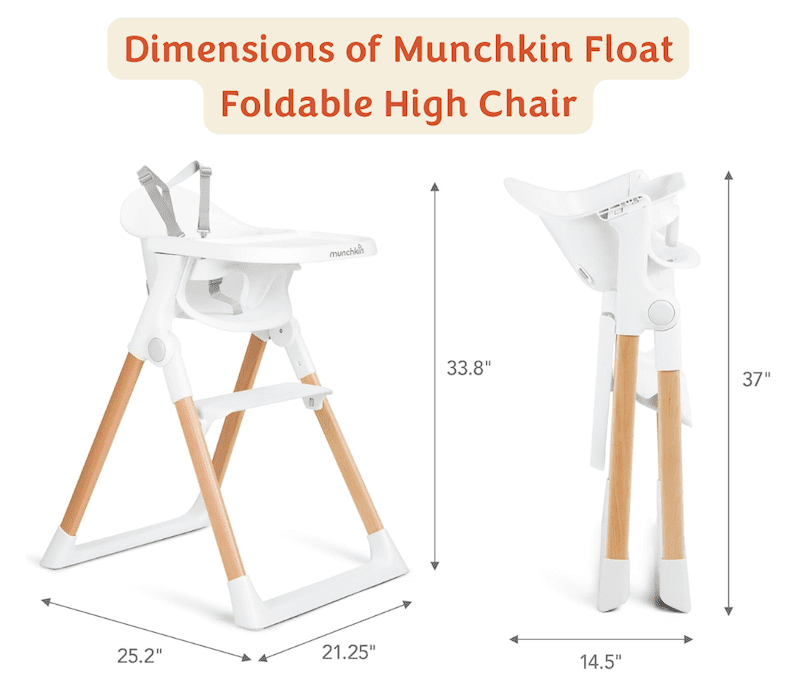
The appeal is the smooth, seamless surface with no foam pad for food to soak into. One important correction to the advice floating around the internet, straight from Munchkin’s own care instructions: do not put this tray in the dishwasher. Munchkin says to wipe the seat, tray, harness and frame with a damp sponge, then wipe dry. If a dishwasher-safe tray is non-negotiable for you, this is the wrong chair. In independent testing, BabyGearLab liked the easy tray and simple harness and wished the leg divider extended further down.
Kelleigh’s Final Verdict: roughly $150–$170 for the slimmest fold here plus a proper adjustable footrest. Buy it if floor space is your binding constraint. Skip it if you want a dishwasher-safe tray, or expect to still be using the chair at three and a half.
Available on Amazon.
5. Best Modern Looking: Abiie Beyond Junior Wooden High Chair with Tray
Gone are the days when parents picked baby gear just to match their home decor. Now, many parents love keeping things in that earthy, boho, neutral vibe—from baby clothes and chairs to boots, plates, spoons, bibs, and car seats. And yep, the same goes for mealtime seats too!
Evidence tier 1–3. I have not owned this one either. It is here on specs, build reputation and parent feedback rather than my own kitchen. On looks and longevity, the Abiie Beyond Junior leads this list.
WHY?
Because it is such a sleek piece of furniture that completes your home decor!

It comes in a range of wood finishes and cushion colours, so check the current options on the listing rather than trusting a number in an article. The frame is FSC- and PEFC-certified European beech.
It is seriously sturdy. Abiie rates it to 250 lb, and that is not a typo or a marketing flourish. The chair is designed to convert into a full-size dining chair, tool-free, so an adult can sit in it. That is the whole value proposition: this chair does not get outgrown, it gets repurposed.
This is one of the most ergonomic baby high chairs available on the market. Positioning the baby in the correct upright and comfortable posture is super easy thanks to its adjustable height feature that lets you set the right seating position.
And to maintain the 90-90-90 rule, the adjustable footrest helps keep the angle between the baby’s knees and elbows at the required level. I’ve explained that position in detail further down.
The restraint is a dual system you can configure as either a five-point or a three-point harness, plus a crotch post, so you can drop to three points once your child is steadier. Abiie backs the chair with a 3-year manufacturer’s warranty, the longest here, and sells optional extensions.
One marketing claim needs correcting, because it gets repeated everywhere, including in an earlier version of this article. Abiie heat-sterilises the wood once during manufacturing, at 248°F. The cushion is water-resistant. Both are real quality steps, but neither is an antimicrobial coating and neither stops bacteria growing on the chair later. No high chair does that. Yours still needs a wipe after meals and a proper deep clean now and then, whatever the box says.
For a solid beech chair with a 3-year warranty and a 250 lb rating, the price stands up well against the plastic convertibles.
Kelleigh’s Final Verdict: the highest entry price here, spread over the longest life, and it becomes a dining chair instead of landing in the garage at age three. Buy it if you want one piece of furniture for a decade and you like the look. Skip it if you need a recline for a pre-solids baby, a fold-flat chair, or wheels, because it has none of the three.
Available on Amazon.
6. Best Convertible: Graco Blossom 6 in 1 Convertible High Chair
With the price of baby gear being so expensive, some parents like to go for gear that grows with their baby!
And this is where convertible chairs come into play. These chairs can do it all, i.e., be it a seating stool, toddler booster seat, or a handy, portable chair when you’re on the go. With so many options out there, finding the best one can feel totally overwhelming, right?
Evidence tier 4. Aiden ate his way through toddlerhood in a Graco Blossom, and it is the chair I picture when I think of him giggling through dinner. It also has the strongest independent backing of the six: Consumer Reports currently ranks the Blossom 6-in-1 first out of the 32 high chairs in its test programme.

Six height positions, three recline positions and a three-position removable footrest, which is the most adjustment on this list. The harness is a convertible 3- and 5-point design, so you start at five points and drop to three when your child is steady. Graco rates it to 40 lb in high chair mode and 60 lb as a booster. The seat pad is wipeable leatherette that also machine washes, and the tray comes off one-handed with a dishwasher-safe pull-out insert.
Do you know it can stand on its own after we fold it? Amazing, right?
The front legs have wheels so you can roll it between rooms, and the rear casters lock so it stays put during the meal. Pair that with the AAP guidance further down: keep the chair away from the table and the counter, because a braced foot against a hard surface is how chairs tip.
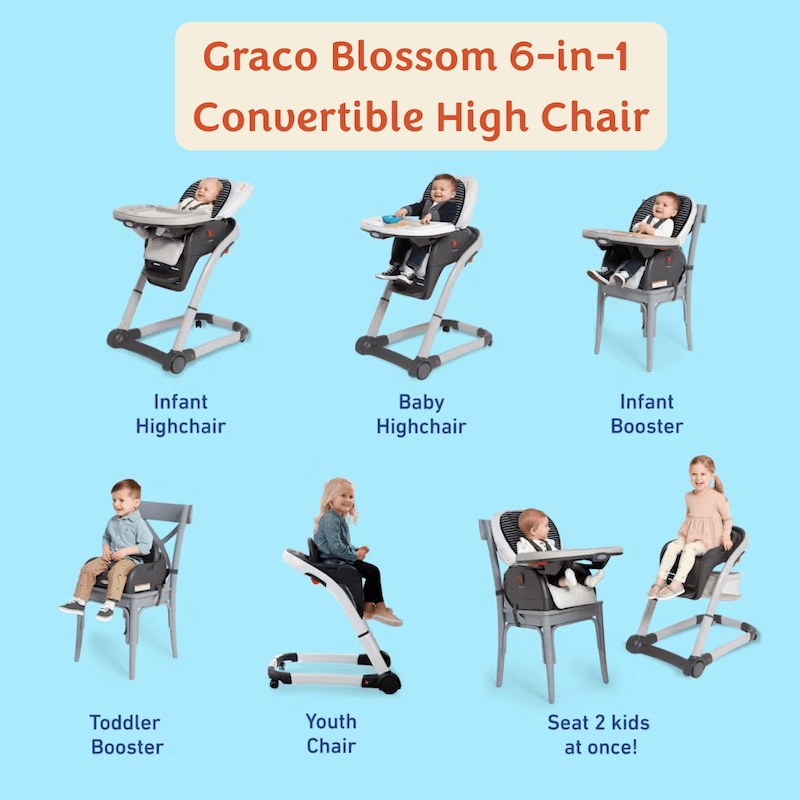
It works for two kids at once—one in booster mode and the other in chair-mounted mode.
It includes an extra seat for the baby.
The one-hand removable tray is dishwasher-safe and easy to clean.
It typically runs $200–$250, and Consumer Reports lists it from $199.99.
Kelleigh’s Final Verdict: six modes, the most adjustment here, wheels, and the best independent test result of the six, at a mid-range price. Buy it if you have two children close in age or want maximum adjustability. Skip it if your kitchen is small, because this is the largest footprint on the list, and the seat stitching does trap stains.
Available on Amazon.
How to Choose a Suitable High Chair for Your Baby? Factors That Parents Should Consider!
I have experienced this journey six times. I feel that children prioritize their preferences and time to sit on these chairs for eating meals. You cannot expect a baby to eat like an adult without making a mess!
HAHA! BUT YOU KNOW WHAT?
That’s how our little ones learn – about the foods, textures, colors, and tastes. As parents, we need to
- Follow their cues,
- Find the most suitable high chair,
- Make sure they are safe in it, and
- Make them learn and enjoy their meals!
Of course, you will choose a chair that matches your interior color theme. Many chairs in the market have that aesthetic, pleasant, and modern look. But there are a few other factors that are necessary too. I am sharing some must-follow things that you should consider while selecting a highchair for your little bundle of joy, including comfort, budget, durability, safety, convertibility, ease of use, compactness, footprint, etc.
1. Comfort:
The high-chair seats must provide proper support and cushioning to the baby’s delicate neck, back, and head (especially if your child is below 1 year of age).
The seat should not be slippery. Some babies settle far better on a padded seat and mine were split on it: Teagan liked the supple cushioning of the GoFirst High Chair, while Theo did better on a firmer seat he could not slide around on. That is a Tier 4 and 5 observation rather than a spec, so treat it as a nudge to try both, not a rule.
Pricier chairs, like the Peg Perego Siesta Chair, add recline positions, adjustable footrests and multiple trays. Of those, the adjustable footrest is the one genuinely worth paying for, because it is what makes the 90-90-90 position possible. Recline is worth far less than the marketing implies, and the section below explains why.
Plain, non-padded ergonomic seats are also comfortable for babies above 6 months, as they can support their neck and back without wiggling. Such chairs are lightweight and easier to clean than ones with padded seats.
2. Budget and Value Considerations:
You don’t need to spend a fortune to get a great high chair. I’ve tested everything from budget finds to high-end models, and here’s what I’ve learned—a higher price doesn’t always equal a better choice.
Before you buy, ask yourself:
- Is it easy to clean after messy meals? Because trust me, you will hate it if it is not.
- Will it grow with your baby or just work for a few months?
- Can it be passed down to your next child or resold?
Some of my favorite chairs were simple, sturdy, and didn’t have all the fancy add-ons. And honestly? That made life easier.
Look for:
- A safe, stable design
- A decent warranty (most brands should offer one)
- Proof it meets the current federal rule, plus the Baby Safety Alliance Verified seal (the programme formerly called JPMA certification) if you want independent third-party testing on top
- A seat your baby actually likes sitting in
If money’s tight, skip the extras. Basic models often do the job just as well—and buying gently used from someone you trust is a smart option.
Convertible high chairs that turn into toddler seats or booster chairs are also a smart buy. One chair, multiple stages—that’s a win.
Kelleigh’s Quick Tip: The manufacturer must provide a specific warranty and replacement if it gets damaged within a time span. Getting a multipurpose chair is a practical option to save money from buying a new chair as your baby grows up.
Recap on Smart Ways to Save
- Second-hand is fine, with two checks first. Look up the model on SaferProducts.gov for recalls, and confirm it was manufactured on or after June 19, 2019, the date the federal high chair rule took effect. Anything older was never required to meet it. Then check the straps are not frayed and the buckles latch properly.
- Don’t go for every shiny feature; prioritize what features matter to you and your family.
- Look for options with reasonable warranty terms.
- Convertible chairs, while being pricey initially, grow up with your child and end up paying for themselves easily.
3. Durability:
The chair must sustain the weight of a growing child. Many chairs on the market are sturdy enough to take high weight capacity. Even adults can sit in such chairs. Such wooden chairs are wonderful due to their cost-saving nature and long-term use.
When my son Theo turned 1, my husband Terry bought the Ezebaby Wooden High Chair, which the manufacturer rates to 250 lb. Worth flagging that this figure comes from the brand rather than independent testing, as is true of most high weight claims. What does hold across the category: a solid wood chair rated well above toddler weight keeps going long after a plastic one has been outgrown, and with a house full of kids ours has doubled as an infant seat, a toddler chair and a study chair.
Also, the seat, tray, and footrest must not be damaged early. As you are investing in these chairs, their manufacturing quality should be good.
4. Safety Restraints:
Many babies squirm and try to escape their safety straps in the beginning.
But to help them learn proper eating habits and safe seating, it’s important to keep them buckled in.
Every chair built for a baby this age should carry at least a 3-point restraint, and plenty of manufacturers go to an adjustable 5-point harness with shoulder straps. Strap padding makes a real difference to how willingly a baby sits: I like the harness on the Momcozy DinerPal Wooden High Chair because the shoulder and belly padding is softer than most.
Here is the part that is genuinely regulated, and where an earlier version of this guide had the details wrong. High chairs sold in the United States fall under a mandatory federal rule, 16 CFR part 1231, which currently incorporates ASTM F404-21. Chairs manufactured on or after June 19, 2019 must comply and must be tested by a CPSC-accepted third-party laboratory.
Do you know that the United States Consumer Product Safety Commission (CPSC) has set some guidelines/rules for chair manufacturers?
That standard is written by ASTM International and two of its requirements are worth understanding as a shopper:
✅ A passive crotch restraint plus at least a three-point restraint system. ‘Passive’ means the seat itself has two separate bounded leg openings, so there is a physical barrier stopping a child sliding down even before you buckle anything. Many chairs go further with a five-point harness and shoulder straps.
✅ Stability testing (forward, sideways, rearward, and with a child climbing in) and permanent warning labels and instructions.
One correction worth making, because I see it repeated constantly: the CPSC does not certify high chairs and neither does ASTM. ASTM writes the standard, the CPSC makes it mandatory and enforces it, and the manufacturer certifies compliance based on third-party lab testing. So there is no ‘CPSC-approved’ sticker to hunt for. The voluntary seal you can look for is Baby Safety Alliance Verified.
The reason any of this matters is in the CPSC’s own numbers. Between January 2011 and September 2017 the agency logged 1,842 high chair incident reports including 271 injuries, and across 2015 and 2016 it estimated about 18,500 high chair injuries treated in US emergency departments. The single most common pattern the CPSC identified was a child standing up on the seat because they were not restrained, and then falling. The harness is not a formality.
5. Convertible or Not?
Well, this is completely OPTIONAL!
But convertible/adjustable chairs are like a GREEN FLAG for parents with budget constraints or large families! Why am I saying this?
Such chairs will be useful to your babies from the infant phase until they become full-size grown children.
Recommended Reading: When to Switch from High Chair to Booster Seat?
I love convertible chairs so much because I have 6 children. These chairs help me to attend to my 2–3 children at a time. E.g. I can adjust the chair height for my youngest one, Theo, while Sawyer sits in her Graco one at dinner.
Here are the ergonomic features that you can look for while considering the convertible/adjustable high chair option:
✅ Height Adjustment:
Children grow WAY TOO FAST!
They become double their size in 6–8 months from their birth. What if your current chair is not height adjustable and your child feels uncomfortable sitting on that smaller chair? You may need to buy another one.
To avoid continuous purchases, a convertible chair with height adjustment saves you!
With these chairs, you can adjust the seat height as your child needs. You can set the seat height as per your dining table’s height so that you can involve your baby in the family dinner.
✅ Footrest Adjustment:
This is also a main thing to consider while choosing a chair for your little one. Your child may feel constrained in a non-adjustable footrest. There must be good legroom to keep their feet on the footrest.
✅ Adjustable Tray:
Tray height and distance matter more than tray quantity. You want the tray close enough that your child can reach food without leaning forward, and ideally at a height where their forearms rest on it comfortably. A dishwasher-safe removable tray or tray insert saves real time, but check the manual rather than assuming. Munchkin, for one, specifically says not to put the Float tray in the dishwasher.
✅ Seat Reclining Options:
This is the one I most want to correct, because an earlier version of this article had it backwards and it matters. Recline is useful before solids start, for a bottle or a rest, when a baby does not yet have the trunk control to sit upright. It is not a choking safeguard.
Feeding solids to a reclined baby does the opposite of what you want. Pediatric occupational therapists, feeding therapists and speech-language pathologists are consistent on this: an upright trunk with the head aligned over the shoulders keeps the airway open so food travels down the oesophagus rather than the airway. Reclining tilts that geometry and raises the risk of aspiration. Feed solids fully upright. If your baby cannot yet hold upright unsupported, that is a sign to wait and talk to your pediatrician, not a reason to recline the seat and start anyway.
6. Toxin-free:
Infants and babies who have entered teething have a habit of chewing things. Their curiosity leads them to put anything in their mouth within their reaching – be it a TV remote, chair tray, cushions, bibs, straps, or anything! Some lower-quality materials can contain toxins that aren’t safe for their tiny bodies.
Worth knowing: ‘toxin-free’ and ‘non-toxic’ are marketing phrases, not regulated certifications. No agency audits them. What is enforced is narrower and more useful: surface coatings on children’s products are capped at 90 ppm lead, and total lead and phthalate limits apply under the CPSIA. Beyond that, look for brands that name specific exclusions (BPA, phthalates, PVC) and say where the figure comes from, and prefer food-contact surfaces made from a single wipeable material. Treat a bare ‘non-toxic’ badge with no detail as decoration.
7. Footprint/Compactness:
If you have a small house or narrow kitchen, high chairs with a smaller footprint would help you. Some chairs have folding features so you can store them in compact spaces.
Some folding chairs are so lightweight that you can take them with you when traveling. They can easily fit in the trunk!
8. Lifestyle/Feature Priorities
Choose what works for your family/household. My recommendations are if you’ve got a small space, consider foldable chairs with a small footprint, whereas if you’ve got 2 kids planned in the same age group, opt for convertible chairs. Safety features are a must, including a 5-point harness and adjustable footrests (to maintain a 90-90-90 position). And my personal thing that I look at most is ease of cleaning, because you don’t want to spend 20 minutes cleaning it after every single meal.
9. Ease of Cleaning
I already touched on this a bit earlier in point #2, but I think this deserves a special mention of its own.
Keeping your high chair clean and fresh is huge and vital for happy mealtimes (and also for your peace of mind if you have cleaning OCD just like me).
Look for detachable trays and seat pads, and check the manual for what is actually dishwasher or machine safe, because it varies more than you would expect. Graco’s tray inserts go in the dishwasher but the frame and pads want soap and warm water only, with no bleach. The Stokke and Ingenuity trays are dishwasher safe. The Munchkin Float tray is not. Guessing wrong is how trays warp.
Avoid chairs with countless nooks and crannies where crumbs love to hide. I’ve learned (the hard way) that a simple design with few crevices is the best friend of any busy parent.
In addition, features like removable harnesses/straps, water-resistant fabrics, etc., are a big plus as they ensure no yucky and stubborn food buildup is left behind.
Kelleigh’s Quick Tip: Make sure you’re doing regular cleaning every day, and don’t miss out on the regular deep clean once in a while. It will keep the chair looking like new and prevent any germs/infections.
Bottom line: There are so many chairs to choose from, and although the process might seem overwhelming. However, sticking to your and your family’s requirements and having something that is easy to clean with the features mentioned above is all you need to know.
Before You Buy: Check Recalls and Skip the Marketplace Bargains
This is the step almost every high chair round-up leaves out, and in 2026 it is the most useful two minutes you can spend.
The CPSC has been working through a wave of high chair recalls and public safety warnings covering models sold online between 2024 and 2026. The affected chairs have included Harppa, Bicystar, Babimoni, Rotinyard, MJKSARE, Funlio and Costway Babyjoy models, sold mostly through large online marketplaces. Two defects come up again and again:
- Missing or failing restraints. Federal rules require permanently attached crotch and waist restraints. Chairs shipped without attached restraints, or with straps and trays that disengage under load, leave a child free to stand and fall.
- Head entrapment gaps. An opening between the seat and tray, or a leg cutout, that lets a child’s body slip through while trapping the head. This one can turn fatal in minutes.
None of the six chairs in this guide appears in those actions, which is part of why they are here. But recalls are published continuously and this article is a snapshot, so do the check yourself rather than trusting my date stamp.
- Search the model on SaferProducts.gov before you buy, and again if you are handed a used chair.
- Be wary of unbranded or unfamiliar-brand chairs on marketplace listings, especially very cheap convertibles with long feature lists. Almost every chair in the recent recall wave fits that description.
- If your chair is recalled, stop using it now and follow the manufacturer’s disposal instructions. Do not sell it, donate it or pass it to a friend.
- Report a dangerous chair or an injury at SaferProducts.gov or on the CPSC hotline, 800-638-2772.
While you are at it, run the American Academy of Pediatrics’ six checks on whichever chair you end up with. Make sure it cannot be tipped easily. If it folds, confirm the lock is engaged every single time you set it up. Use the straps including the crotch strap at every meal, and never let your child stand in the chair. Keep it away from counters and tables, because a child who can brace against a hard surface can push the chair over. Never leave a young child alone in it, and do not let older children climb or play on it. And treat a hook-on table chair as a travel item, not a replacement for a freestanding chair.
High Chair Positioning and 90-90-90 Sitting Rule
My mom always used to say, “Safety first.” I’ve always lived by this principle.
Our pediatrician was the one who drilled proper positioning into me, and an occupational therapist explained the mechanics later. I am not going to retell a second-hand clinical story as if it were my evidence. The reasoning stands on its own without one.
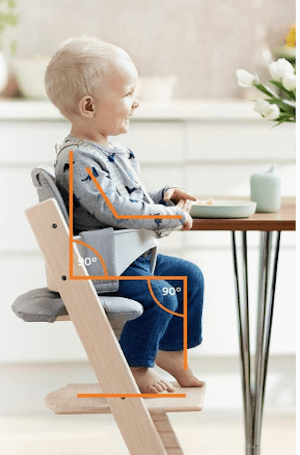
The shorthand is the 90-90-90 position, and it comes from pediatric occupational therapy and feeding therapy rather than from any federal rule or AAP policy. It is a professional convention, widely used by OTs, feeding therapists and speech-language pathologists, and it is genuinely helpful:
- The child should have a 90-degree angle between the knees, hips, and ankles while sitting.
- The child’s shoulders should be over the hips at a 90-degree angle.
- The foot must be kept on the flat footrests for ankle support.
- The child must be able to rest his arm on the table in this sitting position.
Two things come out of that position. The airway stays open, with the head aligned over the shoulders, so food is more likely to go down the oesophagus than the airway. And the body gets a stable base, because feet pressed against a footrest mean your baby is not spending energy on balance. A child braced against nothing tenses up, slides, fidgets and tires, and a tired baby eats worse and less safely.
Which is why an adjustable footrest is the feature I would protect above almost any other, and why dangling feet are worth solving. This is also the reason the Ingenuity is my budget pick rather than my overall pick: it has no footrest at all. I have covered this topic in detail in a separate article if you want the full version.
How did I test and review these high chairs, and why should you trust me?
Let’s be real—picking one of these isn’t just about finding the cutest option online.
What matters is how a chair behaves when your baby is flinging mashed banana and your toddler will not sit still. I have done that six times over. But ‘trust me, I am a mom of six’ is not evidence on its own, so here is the actual basis for every claim in this guide, tier by tier.
No fluff, and no pretending I have personally worn out all six chairs.
1. Which chairs we have actually used (Tier 4)
Four of the six chairs here have been in my kitchen with one of my kids buckled in: the Graco EveryStep (Theo), the Ingenuity SmartClean Trio (Theo), the Stokke Clikk (Sawyer) and the Graco Blossom (Aiden). Those are the picks where I can tell you how the harness behaves on week thirty, how the seams hold oatmeal, and what breaks first.
The other two, the Munchkin Float and the Abiie Beyond Junior, I have not owned. I have labelled them that way in their own sections rather than blurring the line, because that line is the whole point of a guide like this. Those two rest on manufacturer specs, independent testing and parent feedback.
2. The criteria I judge every chair against
Whether a chair is in my kitchen or on my screen, I judge it on the same seven things:
- Safety: Stable frame, certifications, and 3- or 5-point harness system.
- Comfort: How comfortable baby feels when they are in their chair. Do they feel comfy, and is there enough padding for the chubby thighs?
- Ease of Cleaning: This is a big thing for me. The chair should be easily wipeable for regular cleaning. Another thing to look for is machine-washable fabrics and dishwasher-safe trays.
- Adjustability: Convertible options that grow with your baby offer the best value.
- Assembly & Storage: The chair should be foldable and easy to store. And even before that, it should be easy to assemble for a not-too-geeky mom like me.
- Size: The chair should have a small footprint and shouldn’t just take up your entire place.
- Materials: The materials should be chemical and toxin-free, and the frame should feel sturdy and with minimal nooks and crevices.
3. Across ages and stages
Six kids meant using chairs across every stage, from a baby just learning to sit to a toddler who treats dinner as a race to the floor. That range is where you notice things a single-stage test misses: how hard it is to get a wriggling child in and out, whether the harness still holds at the top of the weight range, and whether a chair that suited a 7-month-old still works at two and a half.
4. Regulation and medical guidance come first (Tiers 2 and 3)
Where my experience and a regulator or a pediatric source disagree, the source wins and I change the article. The safety claims in this guide are sourced from the CPSC, the federal rule and the ASTM standard it references, and the American Academy of Pediatrics, not from what worked in my kitchen. That is why an earlier version of this piece has been corrected in three places: the standard version, the certification claim, and the recline advice.
On top of that I use independent testing, Consumer Reports and BabyGearLab among them, plus award programmes like NAPPA and the Baby Safety Alliance verification seal. And I do listen to my mom group, our pediatrician and OT conversations, and reviews, because that is where you hear about the annoyance no spec sheet records. I label that as Tier 5 opinion, because that is what it is.
If something sounds wonderful on paper but drives real moms nuts? I’ll tell you.
5. What I check before anything else
Before a chair makes a shortlist I check the manufacturer’s current spec page rather than a retailer listing, because retailers copy old copy and confuse model years. Then I check the recall database. Specs genuinely change between model years, which is why I tell you where each number came from and ask you to confirm it on the listing you are buying.
6. How this guide makes money
Plainly, so you can weigh it: I do not accept free products or payments from brands, and no brand has any say in what appears here or in what order. This page does contain affiliate links, and I earn a commission if you buy through one. That is compensation, so you should know about it, and it is why the honest thing is to tell you when a cheaper chair is the better buy and when a pick has a flaw. The Ingenuity has no footrest. The Munchkin tray cannot go in the dishwasher. The Abiie has no recline and no wheels. Saying so costs me clicks, which is rather the point.
Why This Matters
Having raised 6 kids of my own, during this parenting journey I’ve learned a lot myself and have figured out what really works.
Six kids taught me what holds up and what does not, and this guide exists to shorten the process for you. The opinions are mine and unpaid. Where I have relied on someone else’s testing or a manufacturer’s figure rather than my own use, I have said which, and you can weigh my recommendation accordingly.
Bottom Line:
You don’t need the fanciest option out there. You need one that fits your family, keeps your baby safe and comfy, and doesn’t make you curse during cleanup. That’s what I look for, and that’s what I share here—straight from one mama to another.
Comparing Features in My Top Picks
Here’s a quick guide to the most helpful features to look for as you shop:
- Adjustable footrest
- Adjustable seat
- Five-point harness vs. three-point harness
- Foldable or not?
- Footprint Size: Critical if you have a small floor area.
- Removable tray
- Reclining feature
- Quality of materials
- Wheels: makes it easy to move the chair.
Here’s how my six picks compare, feature by feature.
Model | Adjustable Footrest | Adjustable Seat Height | Harness Type | Foldable | Removable Tray | Reclining Seat | Wheels | Footprint Size | Easy to Clean |
Graco EveryStep 6-in-1 | Yes | Yes | 5-point | Yes | Yes | Yes | No | Medium | Yes |
Ingenuity SmartClean Trio 3-in-1 | No | No | 5-point | No | Yes | Yes | Yes | Wide | Yes |
Stokke Clikk | Yes | No | 5-point | No | Yes | No | No | Small | Yes |
Munchkin Float | Yes | No | 5-point | Yes | Yes | No | No | Small | Yes |
Abiie Beyond Junior | Yes | Yes | 3- or 5-point | No | Yes | No | No | Small | Yes |
Graco Blossom 6-in-1 | Yes | Yes | 3- or 5-point | Yes | Yes | Yes | Yes | Large | Moderate |
Two things that table cannot show you, and both change the maths.
Weight ceilings, in high chair mode: Ingenuity SmartClean Trio 50 lb; Graco EveryStep and Graco Blossom 40 lb each, rising to 60 lb as a booster (and 75 lb for the EveryStep step stool); Stokke Clikk and Munchkin Float 33 lb each; Abiie Beyond Junior 250 lb, because it converts into an adult dining chair. That range is enormous, and it is really a measure of how many years you get per dollar.
‘Easy to clean’ is not one thing. A seamless wipe-clean shell like the Stokke or Munchkin needs a cloth and nothing else. Chairs with foam or fabric pads, like the Graco pair, clean up fine but on a longer cycle, and stitching holds stains. And dishwasher-safe is per part, not per chair: confirm it in the manual, since the Munchkin Float tray specifically should not go in.
FAQs:
What is the 90-90-90 rule for high chair positioning?
It describes a seated position with roughly 90-degree angles at the hips, knees and ankles, with the feet flat on a footrest and the shoulders stacked over the hips. It comes from pediatric occupational therapy and feeding therapy rather than from any federal rule. Two things make it worth caring about: an upright trunk with the head over the shoulders keeps the airway open so food is more likely to go down the oesophagus, and feet braced on a footrest give a stable base so your baby is not burning energy on balance. I have covered this topic in detail in a separate article in more detail separately.
Is a reclining high chair necessary?
For most families, no. Recline helps a pre-solids baby who does not yet have the trunk control to sit upright, for a bottle or a rest. Do not feed solids in a reclined position. Reclining tilts the airway in a way that raises aspiration risk, which is the opposite of what you want. Feeding therapists are consistent on this point. If your baby cannot yet hold upright with support, that is a signal to wait and check with your pediatrician rather than to recline the seat and begin anyway. Once a baby sits well you will barely touch the recline again, so treat it as a minor tiebreaker, not a headline feature.
Is an adjustable footrest really that important?
It is the feature I would protect above almost any other, and the one most often missing on cheaper chairs. Dangling feet mean your baby tenses to stay balanced, which makes them slide, fidget and tire, and a tired baby eats worse. A footrest at the right height is what makes the 90-90-90 position achievable at all. Of the chairs here, the Ingenuity SmartClean Trio is the one with no footrest, which is exactly why it is the budget pick rather than the overall pick.
How do I check whether a high chair has been recalled?
Search the brand and model on SaferProducts.gov, or call the CPSC hotline on 800-638-2772. Do this before you buy and again before you accept a hand-me-down. The CPSC has worked through a run of high chair recalls and warnings covering models sold online between 2024 and 2026, mostly unfamiliar brands on large marketplaces, with two recurring defects: restraints that are missing or come loose, and gaps between the seat and tray that can trap a child’s head. If a chair is recalled, stop using it and follow the manufacturer’s disposal instructions rather than passing it on.
Should I buy a second-hand high chair?
It can be a sensible saving, with two checks first. Confirm the chair was manufactured on or after June 19, 2019, the date the federal high chair rule took effect, because anything older was never required to meet it. Then look the model up for recalls. After that, inspect the straps for fraying, check every buckle latches and releases properly, and make sure no part of the frame is cracked or bent. Replacement harnesses are available for many models if the webbing is the only problem.
How do I clean OR remove stains from these baby feeding chairs?
Check your product manual first, because dishwasher and machine safety varies per part and per chair. Graco tray inserts go in the dishwasher while the frame and pads want household soap and warm water with no bleach; the Stokke and Ingenuity trays are dishwasher safe; the Munchkin Float tray specifically is not. For daily messes a damp cloth is enough. For stubborn stains like spinach purée or mashed blueberries you can use a good-quality stain remover.
Here’s my secret cleaner tip: mix a pinch of baking soda, vinegar and water into a paste. Leave it on the stain for 5 to 10 minutes, then scrub gently and wipe with a soft sponge or microfibre cloth. Air-dry harness straps rather than tumbling them, because heat weakens the webbing.
When is the right time to start using a high chair?
Around 6 months for most babies, and the milestone matters more than the birthday. You want steady head and neck control and the ability to sit upright with minimal support, alongside the other readiness signs for solids. Your pediatrician is the right person to confirm it. You can read more on start using one. Start with short, supervised sittings so the chair becomes a familiar place rather than a fight.
What is the best high chair for travel?
A travel chair needs to be light, compact, quick to set up and stable once it is up. The Stokke Clikk is my pick: about 8 lb, tool-free assembly in three clicks, and rated to 33 lb. Check the listing for whether a travel bag is included, because the padded bag is a separate Stokke accessory and only some bundles have it. One caution from the AAP: a chair that hooks onto a table is a travel item, not a substitute for a freestanding chair.
Which high chair is convertible (grows with my baby)?
The Graco Blossom 6-in-1 and the Abiie Beyond Junior are the two strongest here, and they solve the problem differently. The Blossom converts through six modes, including seating two children at once, and is rated to 40 lb as a high chair and 60 lb as a booster. The Abiie converts into a full-size dining chair and is rated to 250 lb, so it outlasts childhood entirely. Pick the Blossom for a growing family, the Abiie for one piece of furniture you keep.
Do I need a 5-point harness, or is 3-point enough?
Federal rules require a passive crotch restraint plus at least a three-point restraint, so any compliant chair clears that bar. A five-point harness adds shoulder straps, which genuinely helps with a younger baby or a determined climber, since the most common high chair injury the CPSC identified was a child standing up on the seat unrestrained and falling. Several chairs, including the Graco Blossom and the Abiie, convert between five and three points so you can drop the shoulder straps once your child is steadier. Whichever you have, buckle it every meal and check the fit; if your child can wriggle out, it is too loose.
Key Takeaways for the Best High Chairs for Your Little One:
Choosing a high chair does not have to be overwhelming. If you want the short version, here it is.
- One chair to cover every stage: Graco EveryStep 6-in-1.
- Tightest budget: Ingenuity SmartClean Trio, as long as you accept there is no footrest.
- Small kitchen: Munchkin Float, which folds to about 8 inches deep.
- Travel and eating out: Stokke Clikk, about 8 lb and up in three clicks.
- Two children close in age, or maximum adjustability: Graco Blossom 6-in-1.
- One piece of furniture you keep for a decade: Abiie Beyond Junior.
Whichever you pick, two things are not optional: look the model up on SaferProducts.gov before you buy, and buckle the harness including the crotch strap at every single meal. Those two habits prevent the great majority of high chair injuries, and they cost you nothing.
Happy parenting!